Technanosoft Insights
TMS Integration Checklist: Data, Failure, and Go-Live Controls
A controls-first implementation guide to TMS data ownership, event identity, mapping, failure recovery, acceptance testing, effort estimation, and go-live decisions.

A controls-first implementation guide to TMS data ownership, event identity, mapping, failure recovery, acceptance testing, effort estimation, and go-live decisions.
A reliable transportation management system integration defines ownership, events, validation, recovery, and evidence before it connects production systems. The goal is not merely to move data between a TMS, ERP, and WMS; it is to keep shipment operations correct when data is late, duplicated, incomplete, or temporarily unavailable.
Estimated reading time: 16 minutes. Public author, reviewer, and publication date are pending editorial approval.

Quick answer
A practical TMS integration checklist should answer six questions: which system owns each record, what event moves it, which identifier prevents duplicates, how data is validated, who resolves exceptions, and what evidence proves the workflow is ready. Map one end-to-end shipment flow first. Test duplicates, late events, invalid data, permission failures, outages, and timeouts whose remote outcome is unknown. Go live only when business owners can reconcile records and support teams can safely pause, correct, and replay work.
Key takeaways
| Decision | Practical answer |
|---|---|
| Start point | One complete order-to-shipment-to-settlement workflow |
| Most important design choice | A named system of record for every business object |
| Duplicate control | Stable business operation key plus recorded processing outcome |
| Failure rule | Retry transient failures; correct invalid data; verify unknown outcomes before replay |
| Go-live proof | Expected-versus-actual records, exception recovery, reconciliation, and owner sign-off |
On this page
- Who this guide is for
- What TMS integration includes
- The integration checklist
- Build the integration contract
- Architecture and trade-offs
- Estimate effort and cost
- Choose a connector, configuration, or custom build
- Failure handling and go-live tests
- How Technanosoft approaches TMS integration
- Frequently asked questions
- The decision in one minute
Who this guide is for
This guide is for an operations, product, or technology leader connecting a TMS to an enterprise resource planning system (ERP), order management system (OMS), warehouse management system (WMS), carrier network, customer portal, or finance workflow. It is especially useful when a vendor says an API or connector exists, but your team still needs to define the exact operational behavior.
What TMS integration includes
TMS integration is the controlled exchange of transportation data and actions between the TMS and the systems that create, fulfill, move, track, and settle a shipment. Typical exchanges include order release, warehouse readiness, rate or tender requests, carrier acceptance, pickup and delivery milestones, documents, freight charges, and settlement status.
The connection may use APIs, events, EDI, managed files, or a vendor connector. The transport method matters, but the business contract matters more: “shipment status” can mean a planned state in one system, a carrier-reported event in another, and an approved customer-visible milestone in a third. A field map alone cannot resolve that semantic difference.
Why a connected demo is not enough
A successful demo usually shows the happy path with clean records. Production work includes revised orders, partial shipments, split loads, duplicate carrier events, late scans, changed appointments, time-zone conversions, permission changes, and external outages. If the integration cannot make these conditions visible and recoverable, people will reconcile them in spreadsheets and inboxes.
The first design decision is therefore not “Which endpoint do we call?” It is “Which business outcome must remain correct, and who owns the exception when it is not?”
The TMS integration checklist
Use this checklist as an approval record, not a collection of technical notes.
| Area | Decision to record | Evidence before go-live |
|---|---|---|
| Workflow scope | Trigger, end state, in-scope variants, and manual fallback | Signed workflow map and test scenarios |
| Record ownership | System of record for order, shipment, load, inventory readiness, charge, document, and milestone | Approved ownership matrix |
| Identity | Source ID, destination ID, correlation ID, and stable operation key | Duplicate and concurrency tests |
| Data meaning | Required fields, units, currency, time zone, status vocabulary, null/delete behavior | Field map with representative samples |
| Direction and timing | Push, pull, event, batch, latency target, and ordering rule | Measured test results at representative volume |
| Validation | Structural and business validation before side effects | Rejected-record examples and user-visible reason |
| Access | Service identities, least-privilege roles, secret rotation, document visibility | Role-based access tests |
| Recovery | Retry limit, quarantine, correction, verification, replay, and pause control | Failed-flow recovery test |
| Observability | Correlation, audit history, queue depth, age, failures, duplicates, and reconciliation | Alerts and operator runbook |
| Cutover | Initial data set, in-flight records, rollback boundary, owners, and support window | Rehearsal and go/no-go sign-off |
Map one end-to-end flow before every object
Choose one valuable, bounded workflow such as:
Approved order → warehouse-ready confirmation → shipment creation → carrier tender → accepted load → delivery milestone → approved freight charge
For each arrow, write the source record, destination action, identifier, expected acknowledgement, timeout behavior, and business owner. This exposes gaps earlier than a spreadsheet containing hundreds of field names without context.
Define ownership at the object and field level
“The ERP owns orders” is a start, not a complete rule. The TMS may own the route and carrier, the WMS may own picked quantity and loading readiness, and finance may own the posted invoice. Record who may create, amend, cancel, and publish each state. If two systems can update the same fact, define conflict and version rules rather than defaulting to the last arrival.
Treat identity as a business control
Keep both the source and destination identifiers, but also define a stable key for the logical operation. For example, `source tenant + order version + create-shipment action` is safer than a receive timestamp. Microsoft’s current idempotent-consumer guidance recommends a stable producer or business-level key and recording processed work so repeat delivery does not repeat the side effect. It also warns that deduplication alone does not preserve event order. (Microsoft Architecture Center)
Build the six-part integration contract
The following planning model adapts six useful questions—workflow, users, data, integrations, intelligence, and control—into an integration contract. It is an editorial planning tool, not a claimed proprietary method.
| Contract part | Question | Required artifact |
|---|---|---|
| Workflow | Which business outcome starts and completes the exchange? | Normal path, variants, and stop conditions |
| Users | Who approves, corrects, monitors, and escalates? | Role and responsibility map |
| Data | Which objects, fields, identifiers, versions, and retention rules apply? | Source-to-destination data contract |
| Integration | Which transport, direction, timing, rate limit, and vendor dependency applies? | Interface inventory and sequence |
| Intelligence | Is any prediction, matching, or extraction actually needed? | Decision rule and human-review boundary |
| Control | How are validation, access, audit, retry, reconciliation, and rollback handled? | Control matrix and runbook |
Most TMS connections do not require AI. Deterministic mapping, business rules, and a visible exception queue are usually better for status transitions, quantities, charges, and identifiers. AI may help classify unstructured documents or suggest matches, but it should not silently invent a shipment relationship or approve a financial posting.
Architecture and trade-offs
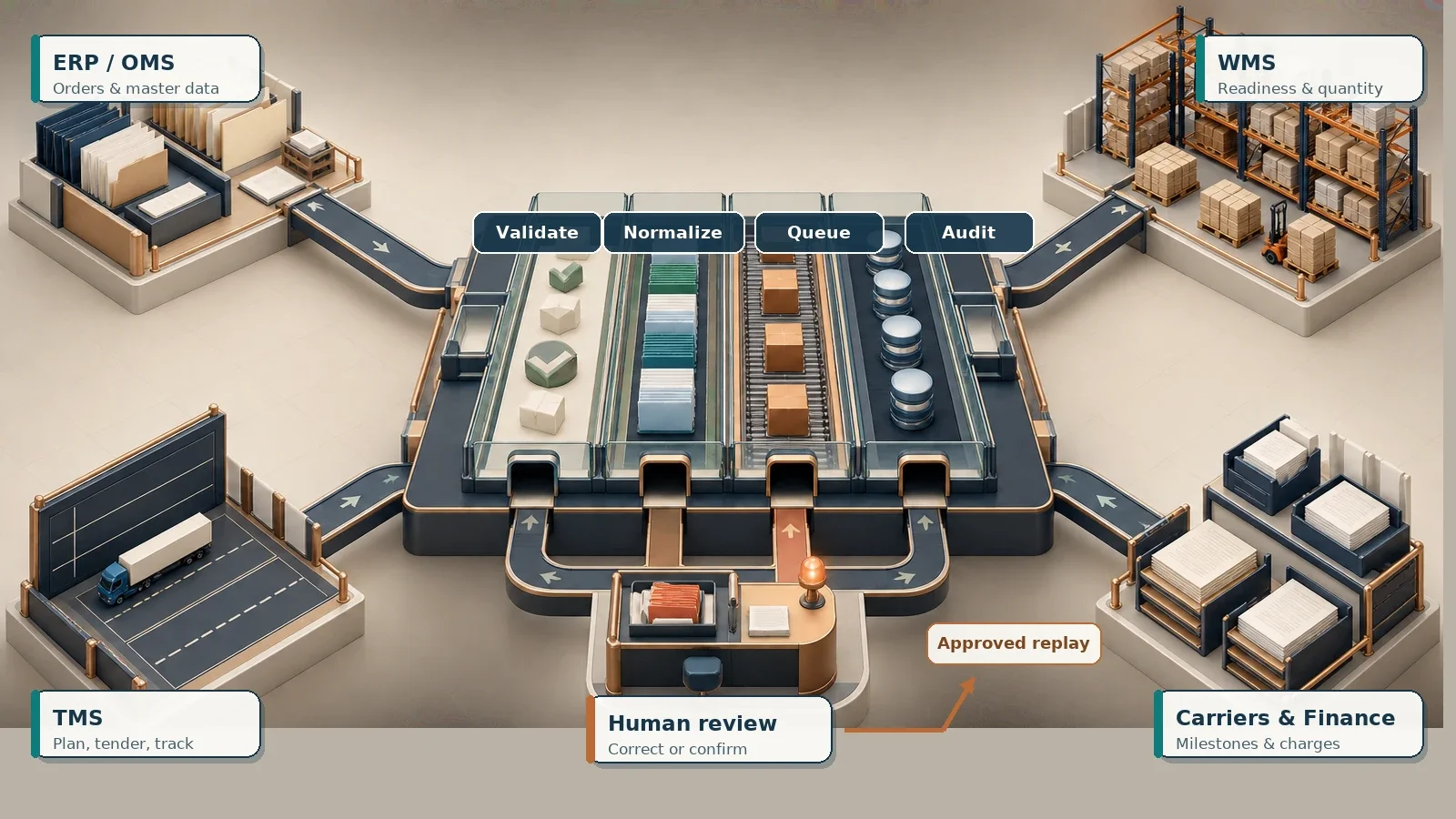
A direct point-to-point connection can be sensible for one stable workflow with low volume and clear ownership. It has fewer moving parts, but mapping and monitoring become duplicated as more systems and partners join.
An integration layer—custom middleware or an integration platform as a service (iPaaS)—adds normalization, routing, credential isolation, queues, audit history, and reusable controls. It also creates another production component that must be operated, secured, and paid for.
Asynchronous queues can absorb uneven demand and isolate a temporarily unavailable target. Microsoft notes that common queue systems may deliver a message more than once; consumers therefore need idempotent processing, dead-letter handling, and explicit ordering rules where sequence matters. (Microsoft queue-based load leveling) AWS similarly lists durable acknowledgement, idempotency, dead-letter queues, monitoring, and retry handling as considerations for asynchronous communication. (AWS Prescriptive Guidance)
Use synchronous calls when the operator needs an immediate answer and the target can meet that dependency. Use asynchronous processing when durable acceptance is more important than an immediate final result. If an asynchronous request returns only “accepted,” expose a status record or callback so operations can distinguish pending, completed, rejected, and unknown.
Estimate integration effort and cost
There is no defensible universal TMS integration price without the actual systems, vendor access, data quality, and acceptance scope. Build the estimate from work units:
Estimated delivery effort = discovery + interfaces + mappings + exception paths + test scenarios + security/operations + cutover/support
Count each item explicitly:
| Cost driver | What changes the estimate |
|---|---|
| Interfaces | Number of systems, partners, environments, and authentication models |
| Objects and events | Create, update, cancel, milestone, document, charge, and reconciliation flows |
| Transformations | Code maps, units, currencies, time zones, address rules, and reference matching |
| Exception paths | Validation, duplicates, late events, unknown outcomes, correction, and replay |
| Testing | Partner availability, representative data, peak volume, edge cases, and evidence |
| Operations | Monitoring, audit retention, support tooling, runbooks, and vendor-change ownership |
Apply the delivery team’s approved rates only after these units are known. Separate one-time discovery, implementation, migration, and cutover from recurring connector licenses, infrastructure, monitoring, support, and vendor API charges. Add uncertainty for undocumented interfaces and partner-controlled test windows; do not hide it inside a fixed-looking range.
Choose a connector, configuration, or custom build
| Approach | Choose it when | Avoid or extend it when |
|---|---|---|
| Standard connector | Supported versions, objects, directions, and recovery behavior match the workflow | “Integration” only means a few fields or one-way export |
| TMS configuration | The platform supports the rules, mappings, roles, and exception states without fragile workarounds | Core behavior depends on manual steps or unsupported custom scripts |
| iPaaS | Several SaaS systems need maintained connectors, reusable mappings, and central monitoring | Licensing or platform constraints exceed the limited scope |
| Custom integration layer | The workflow is differentiated, systems are mixed, or control and audit needs are specific | A supported connector already meets the requirements |
| Manual or batch process | Volume is low, timing is flexible, and a reviewed file is safer than premature automation | Delay and re-entry are already causing material operating risk |
A vendor’s documented API is an interface, not proof of a finished integration. Verify endpoint coverage, write permissions, rate limits, pagination, event delivery, sandbox fidelity, version policy, support boundaries, and the operational tools available when data fails.
At this decision point, teams can discuss the workflow and integration requirements with Technanosoft before estimating a custom layer or extension.
Failure handling and go-live tests

Do not put every failure into the same automatic retry loop.
| Failure class | Example | Safe response |
|---|---|---|
| Transient | Target unavailable before acceptance | Retry with backoff and a limit, preserving the same operation key |
| Invalid business data | Unknown location or prohibited status transition | Stop, show the reason, correct the source or mapping, then replay deliberately |
| Outcome unknown | Request timed out after the target may have committed it | Query or reconcile the target before any replay |
| Permission/configuration | Credential expired or scope removed | Stop and escalate; do not keep retrying unauthorized work |
| Ordering/version | Delivery event arrives before pickup or an older update arrives late | Hold, reorder, or reject according to the documented state rule |
The unknown-outcome branch matters because a timeout does not prove failure. Replaying a shipment creation or charge posting without checking can create a duplicate side effect. Stable keys, stored outcomes, and a target-side lookup reduce that risk.
Minimum go-live test set
- Normal flow with representative data and expected acknowledgements.
- Duplicate creation received sequentially and concurrently.
- Older update received after a newer status.
- Required field missing, invalid code, and intentional empty value.
- Target unavailable before acceptance and after a possibly committed request.
- Permission removed, credential rotated, and unauthorized document access attempted.
- Queue backlog or API throttling at representative peak volume.
- Correct-and-replay flow with an audit record and no duplicate side effect.
- Reconciliation between source and destination counts and selected record values.
- Pause, rollback boundary, manual fallback, escalation, and support handoff.
Microsoft’s go-live guidance calls for system integration, performance, user acceptance, migration, external-dependency, cutover, and operational-support checks. It specifically recommends testing edge scenarios, peak volumes, external-system outages, security roles, and stakeholder sign-off. (Microsoft Dynamics 365 implementation guidance)
For every test, retain the scenario, source and destination references, expected result, actual result, evidence, defect, recovery, retest, and named approver. A green HTTP response is not enough if the wrong charge, status, or shipment record was updated.
Illustrative workflow: a warehouse-ready shipment
Consider a hypothetical shipper whose ERP releases an order, WMS confirms picked quantity, and TMS creates the shipment. The first release uses only this path.
The ERP owns the commercial order. The WMS owns physical readiness. The TMS owns the shipment plan, carrier tender, and transportation milestones. The integration stores all three record IDs under one stable operation key. If warehouse readiness changes before tender, the TMS receives a versioned update. If it changes after carrier acceptance, the event stops for operations review rather than silently rewriting the load.
This is an illustrative design, not a Technanosoft client result. Its value is the decision boundary: the same field change can be automatic in one state and require approval in another.
Technical perspective
The strongest TMS integration is not the one with the most real-time arrows. It is the one where each side effect has an owner, an identity, an observable state, and a safe recovery path. Real-time processing is useful only when the business can support real-time decisions and exceptions.
How to evaluate an integration provider
Ask a provider to show how it will:
- map the actual business workflow before estimating interfaces;
- prove connector depth against your TMS and ERP/WMS versions;
- define ownership, identities, ordering, and conflict rules;
- expose rejected, pending, duplicate, and unknown outcomes to operators;
- test peak volume, permission failures, outages, and replay;
- separate platform license, implementation, and ongoing operating cost;
- document code, configuration, access, support, and change ownership;
- transfer runbooks and acceptance evidence to the team that will operate the integration.
How Technanosoft approaches TMS integration
Technanosoft’s current custom software development service describes workflow mapping, API-based platforms, integrations, secure roles, QA, launch, and support. Its logistics and field operations offering covers dispatch workflows, route visibility, mobile updates, exceptions, admin controls, and reporting. Those capabilities are relevant when a standard TMS connector does not cover the required operating model.
For a TMS integration, a responsible first engagement would clarify one workflow, the participating systems, ownership boundaries, data samples, vendor constraints, failure states, and acceptance evidence. The smallest useful release may be a configured connector, a monitored batch exchange, or one custom event flow—not a replacement platform.
If custom work is justified, the integration should be designed with validation, least-privilege access, durable processing where needed, operator-visible exceptions, and reconciliation from the start. The public GTC Cabs transport management case study demonstrates adjacent transport-platform experience, but it is not presented here as proof of freight TMS integration results.
Frequently asked questions
Which systems usually connect to a TMS?
Common connections include ERP or OMS, WMS, carrier or 3PL networks, telematics or visibility providers, customer portals, document stores, and finance systems. Connect only the systems needed for a defined workflow, then identify the owner for each exchanged object.
Should a TMS integration be real time?
Only where the business decision needs it. Tender responses and operational milestones may need low latency; reference data or reconciliation may work well in batches. Real-time links add availability, ordering, support, and monitoring requirements that should be justified by the workflow.
Is an API the same as an integration?
No. An API exposes operations or data. A production integration also needs mapping, identities, access, error behavior, monitoring, reconciliation, testing, and ownership. Verify the exact objects and write actions you need.
How do you prevent duplicate shipments?
Use a stable key for the logical create operation, store the processing result, and enforce uniqueness where the side effect occurs. A retry must carry the same key. If the same key arrives with conflicting content, stop for review instead of treating it as an ordinary duplicate.
What should happen when a TMS request times out?
First determine whether the target may have accepted or committed the request. Check a status endpoint, search by the stable business key, or reconcile records. Replay only after the outcome is known or the target guarantees the same key cannot create a second result.
When is custom TMS integration justified?
Custom work is justified when supported connectors do not cover the required objects, directions, controls, partners, or operating workflow. It is not justified merely because custom code is possible. Configuration, a standard connector, or a reviewed batch may be simpler and safer.
How long does TMS integration take?
The duration depends on interfaces, vendor access, mappings, data quality, partner testing windows, exception paths, and acceptance scope. Estimate those work units rather than choosing a generic calendar range. A narrowly scoped flow can be planned independently of a broader TMS rollout.
What proves the integration is ready for go-live?
Approved mappings and ownership are necessary but insufficient. Keep evidence for normal, duplicate, late, invalid, unauthorized, unavailable, peak-volume, correction, replay, and reconciliation scenarios, plus a rehearsed cutover and support plan.
The decision in one minute
Do not approve a TMS integration from a connector name or clean-data demo. Approve a specific operating contract. Name the record owner, business event, stable identifier, validation rule, permitted side effect, exception owner, recovery path, and acceptance evidence for each flow. Use the simplest transport and product option that meets those controls. If an existing connector does that, configure it. If it does not, extend or build only the missing control layer.
To plan a first release, share the current workflow, systems, and exception examples with Technanosoft. Public release remains subject to approved authorship, final editorial review, and CMS publication checks.