Technanosoft Insights
Load Tendering Software: Build, Buy, or Integrate?
A controls-first guide to binding each freight tender to one shipment version, carrier, response window, closure state, fallback rule, and confirmed TMS booking.

A controls-first guide to binding each freight tender to one shipment version, carrier, response window, closure state, fallback rule, and confirmed TMS booking.
Load tendering software sends a shipment offer to an eligible carrier, waits for an authorized response, and either secures capacity or moves the load into a controlled fallback. The hard part is not sending a message. It is keeping the shipment version, carrier, rate basis, response deadline, acceptance, cancellation, and TMS status synchronized when data changes or a response arrives late.
Quick answer
Start with a Freight Tender Control Record for each tender attempt. Bind it to one shipment version, carrier, commercial basis, communication channel, sent time, response deadline, and permitted response. Treat accepted, rejected, timed out, withdrawn, failed, and manually handled as different states.
Automate the normal path only after defining what happens when shipment data changes, no carrier responds, a late acceptance arrives, or the TMS cannot confirm the next attempt. Configure an existing TMS when its tendering model fits. Integrate when acceptance exists but is disconnected. Build a focused control layer only when the operating policy or system landscape is genuinely distinctive.

Key takeaways
| Decision | Practical answer |
|---|---|
| Unit of control | One tender attempt tied to one shipment version and carrier |
| Deadline | A business rule with a timestamp, calendar, owner, and expiry action |
| Safe fallback | Move to the next eligible carrier only after the prior attempt is conclusively closed |
| Human-owned exceptions | Changed loads, ambiguous or late responses, manual channels, and exhausted capacity |
| Build threshold | Distinct policy or cross-system orchestration—not a desire for another carrier list |
On this page
- Who this guide is for
- What freight tender automation should control
- The Freight Tender Control Record
- A workable tender flow
- Design the failure and fallback paths
- Buy, configure, integrate, or build
- Pilot and acceptance tests
- Frequently asked questions
Who this guide is for
This guide is for shippers, 3PLs, freight brokers, transportation planners, and systems leaders that offer loads to carriers through a TMS, EDI, API, email, portal, or phone-assisted workflow. It is most useful when planners still chase responses across inboxes and calls, when routing-guide fallbacks are difficult to reconstruct, or when a carrier can appear accepted in one system but unassigned in another.
It is not a carrier-procurement strategy or a universal contract rule. Carrier eligibility, commercial terms, capacity commitments, operating calendars, and tender obligations vary. Procurement, legal, operations, and systems owners should approve the actual policy.
What load tendering software should control
A load tender is a specific offer, not a broadcast notification. The X12 204 Motor Carrier Load Tender is designed to offer a shipment to a truckload motor carrier with scheduling, equipment, commodity, and shipping-instruction detail. The X12 990 is the response to that load tender. Those transaction sets establish message purposes; they do not decide the shipper's ranking, deadline, price tolerance, or exception policy.
A useful workflow answers six questions without reconstructing the story from emails:
- What exactly was offered? Preserve the shipment version, stops, windows, equipment, requirements, commercial basis, and relevant instructions.
- Who received it? Record the carrier identity, eligible service, contact or endpoint, and selection reason.
- When does the offer expire? Store an absolute deadline, the calendar and rule used to calculate it, and the action that follows expiry.
- What did the carrier return? Separate accept, reject, counteroffer, no response, malformed response, and manual response.
- Who or what can commit the load? Define whether the response is automatically binding, requires evaluation, or needs a planner.
- Did the shipment system agree? Confirm that the accepted carrier and current shipment version are booked in the system of record.
Major TMS products expose several of these choices. SAP documents peer-to-peer, broadcast, RFQ-based, and direct tendering, along with carrier ranking, response duration, manual or automatic award, and a mixture of tendering steps. Oracle documents response timers, retendering after declines or timeouts, manual tender channels, and explicit no-resource or maximum-retender states. That variety is evidence that tendering is configurable—not that one default fits every operation.
The Freight Tender Control Record
The Freight Tender Control Record is the original decision-support asset for this workflow. It is the durable history of one shipment's attempts to secure one carrier commitment.
Shipment version and offer basis
Store the shipment ID and version, stop sequence, pickup and delivery windows, equipment, mode, commodity constraints, accessorial assumptions, rate or price limit, currency, and the source of those values. If a relevant field changes after sending, do not silently rewrite the open offer. Withdraw, amend, or create a new attempt according to the approved policy.
Carrier selection and eligibility
Record the carrier ID, service or mode, selection source, ranking position, agreement or rate reference, and eligibility snapshot used at send time. Carrier onboarding and compliance monitoring answer whether a carrier is eligible. Tendering answers whether that eligible carrier commits to this specific shipment.
Attempt, channel, and deadline
Give each attempt a stable identifier. Record the channel—EDI, API, portal, email, or manual call—the destination, sent timestamp, acknowledgement when available, response deadline, calendar, time zone, and timeout rule.
Oracle's current lane tender information allows response time to vary by lane and service provider and can account for a carrier calendar. This illustrates why “wait 30 minutes” should not be buried in code or copied across every lane.
Response and decision
Preserve the raw response or verifiable reference, received time, response type, changed commercial or timing terms, validation result, evaluator, and final decision. An acceptance received after expiry is not automatically equivalent to a timely acceptance. A counteroffer is not an acceptance merely because it arrived through the same endpoint.
Closure and system receipt
Record how the attempt closed: accepted, rejected, timed out, withdrawn, failed, superseded, or manually resolved. Then capture the booked carrier, shipment status, confirmation time, and reconciliation result in the TMS or system of record. “Carrier replied” and “capacity secured” are separate facts.
A workable tender flow
1. Freeze the offerable shipment version
Validate the stops, dates, equipment, requirements, and commercial basis before selecting a carrier. If the load is not ready to be offered, keep it out of the tender queue rather than issuing a tender that operations expects to revise immediately.
2. Select an eligible carrier and policy step
Apply the approved ranking, contract, lane, capacity, and eligibility rules. Store why the carrier was selected and whether this is a direct offer, peer-to-peer step, broadcast request, or manual decision.
3. Create and send one tender attempt
Create the control record before transmission. Send through the chosen channel, preserve the outbound message or reference, and distinguish accepted delivery to the channel from acceptance by the carrier.
4. Start an explicit response window
Calculate the deadline from the current policy, carrier or lane calendar, shipment urgency, and communication method. SAP's tendering profile documentation includes a maximum response duration at each tendering step. The operational lesson is broader: the system should show which clock is running and what happens when it ends.

5. Validate and apply the response
Match the inbound response to the attempt, carrier, shipment version, and deadline. Validate permitted terms and authority. Deduplicate repeated messages. Route counteroffers, mismatches, and late responses to the defined evaluation path rather than forcing them into accept or reject.
6. Close the attempt before fallback
On rejection or timeout, conclusively close or withdraw the open attempt before offering the same shipment to another carrier. Oracle's decline-tender behavior can move a shipment to the next service provider and reaches a no-resources state when no option remains or a retender threshold is exceeded. A bounded workflow needs both the next step and the stopping condition.
7. Reconcile the accepted commitment
Update the shipment's carrier, status, and relevant cost or agreement reference. Confirm that downstream dispatch, appointment, tracking, and communication processes see the same accepted commitment. Alert an owner when the carrier accepted but the booking update failed.
Design the failure and fallback paths
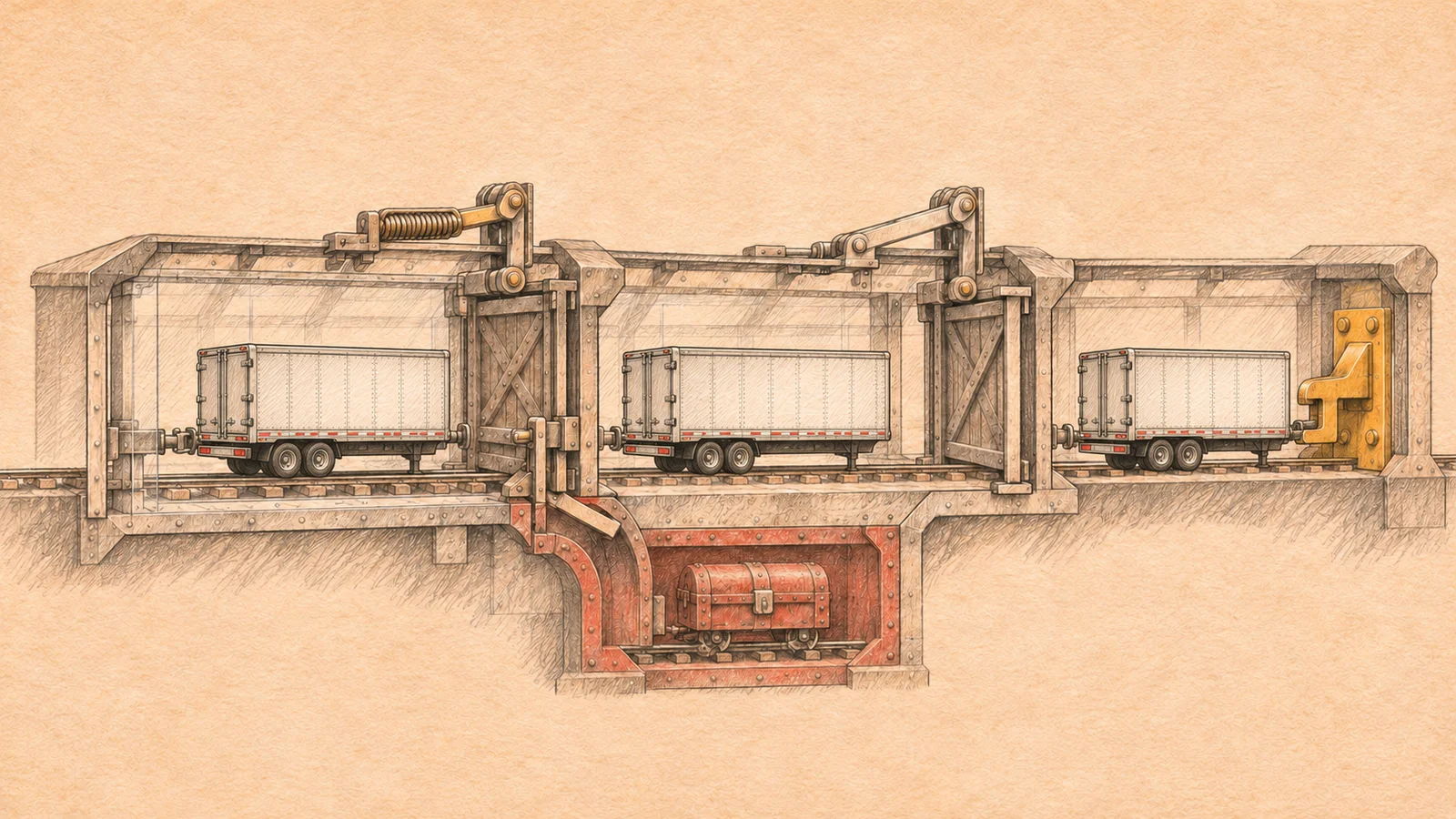
The fallback path is where a simple carrier waterfall becomes an operating control.
| Condition | Controlled response |
|---|---|
| Outbound transmission fails | Keep the attempt unsent or failed; do not start a false response clock |
| Carrier rejects | Close the attempt, retain the reason, then evaluate the next eligible carrier |
| Response window expires | Mark timeout at the stored deadline; withdraw when required before fallback |
| Late acceptance arrives | Quarantine for review; do not displace a later valid commitment automatically |
| Shipment changes while open | Stop, withdraw, or amend under policy; preserve both shipment versions |
| Duplicate response arrives | Match idempotently to the existing attempt and retain one decision |
| Manual channel is required | Create an owned call task and explicit manual result; avoid pretending it has an automatic timeout |
| Maximum attempts reached | Stop at no capacity / no resources and escalate to a planner |
| Accepted update fails in TMS | Preserve carrier acceptance, block further automatic fallback, and reconcile |
Oracle's manual-tender documentation notes that manual tenders do not use the same automatic timeout and that communication configuration errors can create failed tender events. That distinction matters. A phone call, an email delivery receipt, an EDI acknowledgement, and a carrier acceptance are not interchangeable evidence.
Avoid two dangerous shortcuts. First, do not let the system tender to multiple sequential carriers while an earlier offer remains valid unless the business process is explicitly broadcast tendering. Second, do not treat silence as rejection without a stored deadline and policy. Both shortcuts can create double commitments or unexplained carrier behavior.
Buy, configure, integrate, or build?
Configure an existing TMS when
- its tender types, carrier ranking, deadlines, calendars, price controls, and retender limits fit the operating policy;
- carriers can respond through acceptable channels;
- attempt history and exception states are visible to planners; and
- accepted commitments reconcile into downstream execution.
Configuration is usually preferable to duplicating a mature tender engine. Test the difficult paths instead of judging the product from a clean acceptance demo.
Integrate existing systems when
- the TMS can tender but carrier responses arrive in a portal, email inbox, EDI gateway, or network that is not synchronized;
- carrier eligibility and commercial data live in separate systems;
- accepted tenders do not reliably update dispatch or appointment workflows; or
- operations cannot trace a response back to the exact attempt and shipment version.
A focused integration should preserve identifiers, timestamps, message references, and failure receipts. It should not invent a new status vocabulary when the TMS already owns the state.
Build a focused control layer when
- one workflow must coordinate several TMS instances, carrier networks, or communication channels;
- the organization has distinctive tender steps, response policies, approval boundaries, or customer rules that products cannot express;
- planners need one governed exception queue across systems; or
- the system of record cannot preserve the attempt-level evidence required by operations.
Do not build a carrier marketplace or routing guide simply because a connector is inconvenient. Carrier master data, eligibility, agreements, ranking, calendars, communication reliability, security, support, and recovery become ongoing product responsibilities.
A useful discovery artifact is not a screen mockup. It is a state-and-authority map showing who can create, accept, withdraw, retender, override, and reconcile each tender attempt.
Technanosoft's logistics and field operations software service covers dispatch, route, approvals, exception handling, integrations, and operational reporting. Its custom software development service covers workflow approvals, API-connected platforms, and operations dashboards. Those pages establish service scope, not a claimed freight-tendering client result. Teams evaluating a gap can discuss the workflow and integration boundary without assuming custom software is the answer.
Pilot and acceptance tests
Pilot one mode, a bounded lane group, and a small carrier set. Record the current manual process first: tenders sent, acceptance and rejection handling, time to response, follow-up work, late responses, exhausted routing guides, manual calls, changed shipments, and booking-update failures. Do not invent a savings percentage before measuring the baseline.
Test at least these cases: clean acceptance; explicit rejection; timeout; carrier-calendar boundary; duplicate response; late acceptance after fallback; counteroffer; changed pickup window; changed equipment; EDI or API transmission failure; manual carrier; carrier accepts while TMS write fails; maximum retenders reached; planner withdraws an open tender; and two workers process the same inbound response.
The release gate should require more than message success. Confirm that the right carrier accepted the right shipment version within the right window, the prior attempt is closed, the TMS reflects the commitment, downstream users see it, and the complete history can be reconstructed.
Frequently asked questions
What is load tendering software?
It is the controlled process of offering a shipment to one or more eligible carriers, collecting responses, applying deadlines and award rules, falling back when necessary, and recording the accepted commitment in the transportation system.
Is an X12 204 the same as a carrier acceptance?
No. The 204 is used to tender the load. X12 defines the 990 as the response to that tender. A receiving acknowledgement or successful transmission is not, by itself, a carrier commitment.
Should every rejected or timed-out tender move automatically to the next carrier?
Only when the prior attempt is conclusively closed, the next carrier remains eligible, the shipment version is still current, the retender limit has not been reached, and the approved policy permits automatic fallback.
How long should a carrier have to respond?
There is no universal duration. The response window may depend on lane, carrier, calendar, shipment urgency, communication channel, agreement, and operational coverage. Store the rule and the resulting absolute deadline.
What happens if shipment details change after tendering?
Define which changes require withdrawal, amendment, or a new attempt. Preserve the version originally offered and do not silently apply acceptance to materially different work.
Can AI choose the next carrier?
AI can summarize exceptions or support planners, but carrier eligibility, ranking, commercial limits, deadlines, and commitment authority should remain governed by approved data and policy. A generated recommendation should not create an invisible tender.
What is the smallest useful first release?
One shipment version, one carrier-selection source, one outbound channel, an explicit response deadline, validated accept/reject/timeout states, bounded fallback, a planner exception queue, and reconciliation into the TMS.
The decision in one minute
Freight tender automation is valuable when planners chase carrier responses, deadlines live in inboxes, fallbacks are hard to explain, or an accepted load can remain unbooked in the TMS.
Start with one Freight Tender Control Record per attempt. Preserve the shipment version, carrier, offer basis, channel, deadline, response, closure, and system receipt. Close the prior attempt before sequential fallback. Keep manual channels and late responses explicit. Stop automatically when eligibility, capacity, or attempt limits are exhausted.
Configure an existing TMS when its model fits. Integrate when tender and response data are trustworthy but disconnected. Build only when cross-system orchestration or operating policy is genuinely distinctive. The goal is not a faster message. It is one explainable carrier commitment for the current load.