Technanosoft Insights
Cold Chain Monitoring Software: From Excursion to Release Decision
A decision-first guide to connecting cold-chain sensor evidence with product identity, custody, excursion holds, offline data, and authorized release.

A decision-first guide to connecting cold-chain sensor evidence with product identity, custody, excursion holds, offline data, and authorized release.
Cold chain monitoring software should do more than draw a temperature line and send an alert. It must connect each observation to the correct product, device, journey, location, and custody period; preserve what happened when a logger reconnects late; place affected inventory under controlled review; and record who decided whether it could move again. The valuable output is not a dashboard. It is a defensible operational decision.
Editorial draft: November 16, 2026 · Estimated reading time: 13 minutes
Quick answer
Cold chain monitoring software collects environmental observations from loggers, probes, gateways, storage units, and vehicles, then turns them into controlled exception workflows. A reliable system preserves raw evidence, event time, product and custody identity, rule version, alert delivery, corrective action, and the final hold or release decision. Start with one product class and one handoff. Define approved limits with quality and regulatory owners before selecting devices, integrations, or automation.
Key takeaways
| Question | Decision-first answer |
|---|---|
| What should be designed first? | The product-specific decision and evidence required, not a universal dashboard. |
| Is every alert an excursion? | No. A reading, rule evaluation, excursion case, and disposition decision are different records. |
| What identity problem matters most? | Product, logger, container, journey, location, and custodian assignments all change over time. |
| How should offline data be handled? | Preserve observation time and arrival time; late evidence may reopen or change a case. |
| When is custom software justified? | When standard monitoring works but the cross-system hold, investigation, custody, or release workflow is distinctive. |
On this page
- Who this guide is for
- Start with the release decision
- Separate reading alert excursion and disposition
- Build an excursion decision record
- Keep identities and custody separate
- Design for offline and late evidence
- Connect alerts to operational holds
- Choose buy integrate or build
- Roll out safely
- FAQs
Who this guide is for
This guide is for operations, quality, logistics, product, and technology leaders who need to monitor temperature-sensitive goods across storage, transport, receiving, or handoff. That can include food, vaccines, pharmaceuticals, laboratory material, or other products whose approved conditions depend on time, temperature, humidity, light, shock, or another environmental factor.
It is not product-specific compliance advice. Limits, allowed duration, calibration requirements, retention, and release authority must come from approved product information, quality policy, contracts, and applicable regulation. The purpose here is to design the software boundary that keeps those rules and decisions explicit.
Start with the release decision
A request such as “notify us when the temperature goes out of range” is incomplete. It does not say which product rule applies, whether a brief deviation is treated differently from a sustained exposure, what happens while the device is offline, who receives the alert, or which system prevents the affected inventory from shipping.
Start with the business decision and work backward.
| Operational decision | Evidence needed | Control to define |
|---|---|---|
| Accept a receipt | product/lot identity, journey, logger assignment, exposure history, custody handoff | who may accept, hold, or request review |
| Keep inventory available | storage-unit observations, approved rule, open excursions, device health | whether WMS/ERP availability follows the quality state |
| Move goods to quarantine | affected scope, location, alert time, responsible team | physical and digital hold confirmation |
| Release or reject goods | complete evidence, investigation, approved authority, reason | immutable decision history and downstream synchronization |
| Respond to an audit or trace request | source records, chain of custody, transformations, decision trail | exportability, provenance, and retention policy |
The same temperature line can support different decisions. A receiving team may need a journey summary before acceptance. A quality reviewer may need the complete interval, device status, and product rule. A warehouse system may only need the current hold state and its authorized source. Designing one “status” field for all three creates ambiguity.
Separate reading, alert, excursion, and disposition
Cold-chain systems often collapse four different things:
- Reading: an observation made by a sensor at a particular time, with unit and device context.
- Alert: a notification or workflow signal produced by a rule evaluation or device condition.
- Excursion case: a bounded investigation that links affected product, exposure interval, evidence, owners, and actions.
- Disposition: an authorized decision such as release, continued hold, reroute, return, reject, or another approved outcome.
A single unusual reading may be a probe-placement issue, a door-opening event, a delayed upload, or evidence of a true exposure. Conversely, the absence of an alert does not prove acceptable condition if the logger battery failed or the assignment was wrong.
CDC's current vaccine guidance offers a useful concrete example: a continuous digital data logger provides history and information about how long a unit operated outside the recommended range, while an excursion triggers a controlled response rather than an automatic claim of usability. The exact rule is product-specific, but the software lesson applies more broadly: evidence collection and release authority are separate.

Build an excursion decision record
The core record should answer six questions without reconstructing the incident from screenshots and email.
1. What product and scope were affected?
Record the product or product class, lot or batch where applicable, handling unit, quantity scope, journey or storage episode, and current location. Do not assume the sensor identifies the goods merely because it was physically nearby.
2. Which requirement applied?
Store the approved rule reference and version used for evaluation. The system should not invent one global “safe” range. Product labeling, quality procedures, contracts, and regulators may define different conditions and decision owners.
3. What was observed?
Preserve raw readings or a durable reference to them, observation time, unit, source device, probe channel, calibration state if available, and data quality. Normalized values can support evaluation, but they should not erase the source evidence.
4. What exposure interval did the system infer?
Record start, end, duration logic, missing intervals, interpolation policy, and the rule version. A chart is useful for a reviewer; a reproducible evaluation is more useful for an audit.
5. What happened in custody and operations?
Link receiving, shipping, door, power, route, loading, and handoff events where relevant. FDA's food traceability framework distinguishes Critical Tracking Events and Key Data Elements for covered foods. Those records do not automatically establish acceptable temperature, but they show why environmental evidence and supply-chain identity need a common timeline.
6. Who decided what?
Record case ownership, notifications, corrective actions, supporting evidence, reviewer, decision, reason, time, and downstream acknowledgments. A release state without authority and rationale is only another mutable flag.
Keep product, device, journey, and custody separate
One logger is not one shipment forever. It may be configured, calibrated, installed in a storage unit, placed inside a tote, moved between pallets, returned, recharged, and reused. A reefer or cold room can contain several lots with different requirements. A journey can cross carriers and facilities. A product can change handling unit without changing lot identity.
Maintain time-bounded assignments for:
- product or lot to handling unit;
- handling unit to shipment or storage episode;
- sensor or logger to probe position, container, pallet, vehicle, or storage unit;
- journey to route, stop, or custody segment;
- location to operating time zone and approved handling context;
- person or role to investigation and release authority.
The assignment boundary matters during handoff. If a receiving clerk scans a pallet but the logger is still associated with the previous shipment, an apparently valid reading can be attached to the wrong goods. If a logger is removed before its final offline observations upload, those readings still belong to the earlier journey.
Design for offline loggers and late evidence
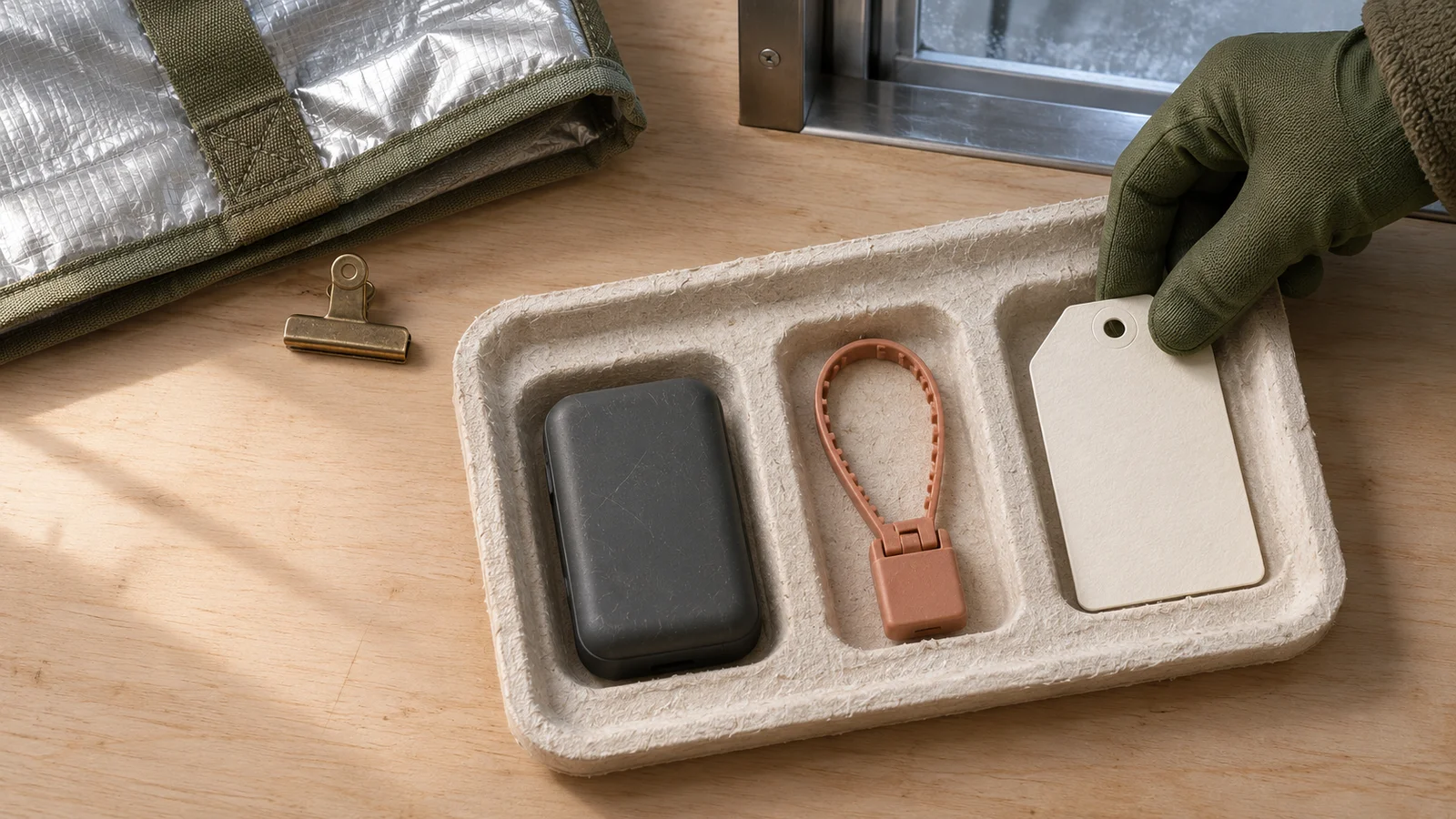
Not every device streams continuously. WHO catalogs monitoring approaches ranging from indicators and data loggers to remote event-monitoring systems. Trucks, airport areas, insulated shippers, rural routes, metal enclosures, and device power policies can all interrupt connectivity. Software should distinguish “no excursion detected” from “no complete data received.”
Preserve at least four times where available:
- Observation time: when the sensor measured the condition.
- Device-record time: when the device committed the sample or event.
- Received time: when the platform obtained it.
- Business-effective time: when a hold, release, or other decision took effect.
GS1 EPCIS makes a similar distinction in its sensor model: sensor observation time is not the same as the time of the related business event. That distinction matters when a logger is downloaded at receiving. Evidence may arrive after the shipment, yet describe an earlier segment.
Late evidence needs an explicit policy:
- deduplicate by stable device record identity or a documented composite key;
- retain arrival order and event order separately;
- detect gaps, resets, clock drift, time-zone errors, and impossible intervals;
- reopen or supersede a case when permitted rather than overwriting its history;
- prevent an automatic release while required data is incomplete;
- reconcile uncertain downstream writes before retrying them.
“Real time” is not a substitute for completeness. A well-designed batch download can be appropriate when the operating decision occurs at receiving. A streaming alert can be appropriate when someone can intervene during transport. The required action determines the latency requirement.
Connect alerts to operational holds
An alert that lives only in a monitoring portal can be acknowledged while the affected inventory remains available in WMS, ERP, or dispatch. A safe integration defines which system owns each state and how failures are exposed.
| State | Meaning | Typical system behavior |
|---|---|---|
| Detected | rule or device condition requires attention | create or update a case; notify the assigned role |
| Held | affected scope is prevented from normal movement | send a stable hold reference to operational systems and confirm receipt |
| Investigating | evidence and corrective action are being reviewed | preserve case history; allow bounded evidence additions, not silent rule changes |
| Dispositioned | an authorized decision is complete | propagate release/reject outcome idempotently and retain acknowledgments |
CDC's vaccine excursion resource illustrates the control pattern clearly: identify the event, keep affected product separated and marked not to use, document the details, correct the immediate condition, and obtain appropriate guidance. Different industries use different terms and authorities, but software should preserve the distinction between a notification and a verified hold.

Decide which system is authoritative
| Record or decision | Typical authority | Integration responsibility |
|---|---|---|
| Raw observation | device/logger platform | preserve source, time, unit, and provenance |
| Product and lot | ERP, WMS, LIMS, or agreed master | use stable identifiers and effective-dated mappings |
| Shipment and custody | TMS, WMS, carrier, or traceability system | correlate handoffs without rewriting source events |
| Evaluation rule | approved quality configuration | version, authorize, test, and audit changes |
| Operational hold | quality workflow integrated with WMS/ERP | use stable case identity and confirm downstream state |
| Release or rejection | authorized quality/business role | record rationale and propagate idempotently |
If systems disagree, do not choose the newest timestamp automatically. A sensor platform can own its readings; it may not know which product was in the container. WMS can own inventory location; it may not know that an offline logger later revealed an exposure. The excursion case is the reconciliation boundary.
Choose buy, integrate, or build
Most teams should not build sensor firmware, logger management, and charts from scratch when a suitable monitored platform already exists. Custom work is usually more defensible around integration and decisions.
| Option | Choose it when | Main caution |
|---|---|---|
| Buy a monitoring platform | device support, rules, alerts, reports, and workflow fit the requirement | verify exports, APIs, assignment history, offline behavior, roles, and exit path |
| Integrate existing systems | monitoring is adequate but WMS/TMS/ERP and quality states are disconnected | define authority, idempotency, reconciliation, and support ownership |
| Build a custom workflow layer | investigation, custody, product rules, approvals, or partner exchange are distinctive | avoid recreating commodity device management without a clear reason |
| Build a broader platform | multiple device vendors and business units need one governed event and decision model | fund governance, validation, support, migrations, and long-term ownership |
When partner interoperability matters, EPCIS may provide a common visibility-event model, including sensor metadata. It is not automatically the right choice for an internal single-site workflow. Select the smallest architecture that preserves the required evidence and decisions.
Scope and cost drivers
A responsible estimate depends on:
- product classes and rule variants;
- device vendors, connectivity patterns, sample volume, and offline duration;
- lots, handling units, shipments, facilities, vehicles, and custody partners;
- WMS, TMS, ERP, LIMS, quality, messaging, and identity integrations;
- calibration, clock, unit, time-zone, and missing-data policies;
- hold, investigation, approval, escalation, and release roles;
- audit, validation, security, retention, and data-residency requirements;
- rollout, parallel run, support, and device or vendor migration.
These inputs matter more than a generic per-screen estimate. Do not promise a cost or timeline until the evidence flow and integration boundaries are mapped.
Roll out one controlled lane
Begin with one product class, one facility or route, one device family, and one release decision. A useful pilot proves the unpleasant cases as deliberately as the happy path.
- Map product, handling-unit, logger, journey, location, and custody identities.
- Obtain approved rules and decision owners from the appropriate quality and business authorities.
- Replay representative normal, out-of-range, missing, duplicate, late, clock-shifted, and device-reset data.
- Run alerts in observation mode before they control inventory.
- Confirm that digital holds match physical operations and downstream availability.
- Test lost connectivity, failed notifications, rejected writes, retries, and reconciliation.
- Compare system evaluation with authorized human review during a bounded parallel period.
- Define rollback, support ownership, and the evidence required to expand.
Common implementation mistakes
| Mistake | Consequence | Better approach |
|---|---|---|
| One threshold for every product | false confidence or unnecessary holds | version product-specific approved rules |
| Logger ID treated as product identity | evidence attaches to the wrong goods | maintain effective-dated assignments and scan handoffs |
| Arrival time treated as observation time | late data changes the apparent sequence | retain both times and order by purpose |
| Alert acknowledged without inventory hold | goods continue moving during review | integrate a stable case and confirm downstream state |
| Dashboard screenshot used as evidence | transformation and completeness are unclear | preserve raw records or durable references and evaluation version |
| Automatic release after data returns | authority and context are bypassed | require the approved decision path |
How Technanosoft approaches the workflow
Technanosoft publicly positions its logistics and field-operations work around mobile workflows, exception handling, role-based controls, reporting, and API-ready systems. For cold-chain monitoring, that suggests a workflow-first engagement: map the current handoff, evidence, hold, and release path; identify the system of record for each identity and decision; then choose where standard software is sufficient and where an integration or custom application adds control.
A practical first engagement can produce an event and identity map, source-system inventory, excursion-case model, role matrix, integration boundaries, failure policy, and pilot scope. That is enough to compare vendors and estimate implementation without pretending the device or dashboard is the whole solution.
Discuss a cold-chain workflow or review Technanosoft's logistics and field operations software and custom software development capabilities.
Frequently asked questions
What does cold chain monitoring software do?
It collects and evaluates environmental observations from storage and transport, connects them to products and custody events, alerts responsible people, supports investigation, and records hold or release decisions. Device management and charts are only part of the workflow.
Is a temperature alert the same as a temperature excursion?
Not necessarily. An alert is a signal produced by a rule or device condition. An excursion case is a controlled record that defines affected scope, evidence, investigation, and disposition. Product-specific authorities determine whether an exposure is acceptable.
Should cold chain software work offline?
The operating workflow should anticipate offline devices and locations. Some loggers store observations for later download; some gateways buffer and forward; some indicators are not continuous digital sources. The design should expose incomplete data and preserve observation time when records arrive late.
How does cold chain monitoring connect to traceability?
Traceability links product and supply-chain events; monitoring records environmental evidence. They should share stable identifiers and time-bounded custody context, but neither automatically proves the other. For covered foods, FDA requirements need a separate applicability review.
When should a company build custom cold-chain software?
Build when the defensible need is a distinctive cross-system workflow, identity model, partner exchange, investigation, or approval process that suitable standard products cannot support. Prefer integrating proven devices and monitoring platforms where they fit.
What should be tested before automation controls inventory?
Test correct and incorrect assignments, missing and late readings, duplicate records, device resets, clock drift, connectivity loss, rule changes, alert failures, rejected downstream writes, physical hold confirmation, authorized release, and rollback.
The decision in one minute
| If your situation is… | Consider… |
|---|---|
| You need basic monitoring for one standard workflow | buy a suitable supported platform |
| Alerts work but operations remain disconnected | integrate monitoring with the quality and inventory hold workflow |
| Several devices and partners create inconsistent evidence | define a governed identity and event model before adding dashboards |
| Offline data can arrive after receiving | preserve observation and arrival time and define case-reopen rules |
| Release depends on product-specific judgment | keep authorized disposition separate from automated detection |
The cold chain is not protected by visibility alone. It is protected when evidence remains attached to the right product and custody period, missing data is visible, alerts create controlled holds, and release decisions are authorized and durable. Start with one handoff and one decision. If the system can explain what happened, what was affected, what evidence was incomplete, and who approved the outcome, it is ready to earn a wider operational role.