Technanosoft Insights
Carrier Onboarding Automation: Build, Buy, or Integrate?
A controls-first guide to carrier intake, source verification, exception review, approval, TMS handoff, monitoring, and the build-buy-integrate decision.

A controls-first guide to carrier intake, source verification, exception review, approval, TMS handoff, monitoring, and the build-buy-integrate decision.
LOGISTICS SOFTWARE
Carrier onboarding automation should collect the packet, check approved sources, route mismatches to a reviewer, record the decision, and pass only approved carrier data into the transportation management system (TMS). Most freight brokers and 3PLs should buy the commodity verification layer and integrate it with their workflow; custom development makes sense when policy, exceptions, or downstream systems are materially different.
Draft for internal editorial review · Approximately 14 minutes

Quick answer
Carrier onboarding automation is a controlled workflow for collecting carrier details and documents, checking current source data, applying your approved qualification rules, escalating exceptions, recording who approved or rejected the carrier, and synchronizing the result with your TMS. Buy a platform when the workflow is standard. Integrate when an existing product covers verification but your TMS or approval process needs adaptation. Build only when unique policies, systems, data ownership, or scale create a durable advantage.
Key takeaways
| Decision | Practical answer |
|---|---|
| First automation target | Intake, completeness, source checks, reminders, and status routing |
| Keep human control over | Identity mismatches, unusual insurance or authority states, policy exceptions, payment changes, and final release authority |
| Best default | Buy the commodity data/verification capability and integrate it with your approval and TMS workflow |
| Do not treat as proof | An uploaded document, a stale public record, or a model-generated confidence score |
| Design for after approval | Expiry monitoring, material changes, holds, re-review, and an evidence trail |
On this page
- Who this guide is for
- What carrier onboarding automation includes
- Build, buy, or integrate
- Six planning questions
- Workflow and architecture
- Scope, effort, and operational value
- Choose it when—or avoid it
- Risks and exception controls
- Provider selection
- Technanosoft's approach
- FAQs
- The decision in one minute
Who this guide is for
This guide is for a US freight brokerage or 3PL operations leader who has a working carrier-setup process but sees repeated email chasing, duplicate entry, inconsistent checks, slow exception handling, or weak visibility after approval. It is not a substitute for legal, tax, insurance, or safety advice. Your qualified teams must define the actual policy and approval standard.
What carrier onboarding automation includes
Carrier onboarding begins before a carrier is eligible to receive a load. The workflow usually collects identity and contact information, USDOT/MC identifiers, a broker-carrier agreement, insurance evidence, tax information, payment or factoring details, equipment and lane information, and internal notes. It then checks what can be checked, routes exceptions, records a decision, and creates or updates the carrier in connected systems.
The distinction that matters is presence versus verification. A file upload proves that a file arrived. It does not prove the information is current, belongs to the same legal entity, satisfies your policy, or came from an approved channel. Public FMCSA sources help, but they also have scope and freshness limits: the SAFER Company Snapshot uses government systems and is updated on different cadences for different data, while SAFER does not preserve historical safety-rating data in the public snapshot (FMCSA SAFER FAQ).
Why manual carrier setup breaks down
| Current problem | Operational effect | Useful software response |
|---|---|---|
| Packets arrive through several inboxes | Missing files and uncertain ownership | One carrier-facing intake with required fields and document status |
| Staff retype carrier data | Duplicate records and transcription errors | Resolve the carrier to a stable identifier and map approved fields |
| Checks are performed differently | Inconsistent decisions and weak review evidence | Versioned rules, reviewer roles, and reason codes |
| A source is unavailable | Teams guess, wait without visibility, or bypass a check | Explicit unavailable/stale state, retry policy, hold queue, and escalation |
| Approval ends the workflow | Expiry and material changes can be missed | Monitoring events, re-review, holds, and TMS status synchronization |
| Payment details change by email | High-risk changes can bypass normal review | Separate change workflow with verification and dual approval where policy requires it |
Build, buy, or integrate?
For most brokers and 3PLs, the answer is integrate: use a focused product or approved data service for commodity capabilities, then connect it to the organization's policy, approval, and TMS workflow. Building every data connector and document feature from zero creates maintenance work without necessarily creating a business advantage.

| Path | Choose it when | Main trade-off | Proof to request |
|---|---|---|---|
| Buy | Your packet, rules, monitoring, and TMS connection fit a mature product | Faster adoption, but less control over workflow and data model | Source coverage, evidence retention, exportability, roles, support, and real integration behavior |
| Integrate | A product handles collection or verification, while your approval steps and TMS need adaptation | Multiple systems and contracts must remain reliable | Stable API/webhook contract, retry behavior, field ownership, reconciliation, and failure queues |
| Build | Your policy, user roles, operating model, source mix, or downstream workflow is materially unique and long-lived | Highest ownership and maintenance responsibility | Source access, legal review, security model, test plan, support capacity, and change budget |
| Keep the current process | Volume is low, exceptions dominate, or the policy is still changing | Manual effort remains, but premature software is avoided | A measured baseline and a clear trigger for reconsidering automation |
Do not select a path from a feature checklist alone. Ask which party owns source changes, false matches, source outages, evidence retention, carrier support, data export, and the final decision.
Six planning questions
Use these questions as a draft planning framework, not as a claimed proprietary methodology.
- Workflow: Where does onboarding start, what makes an application complete, and what event authorizes the first load?
- Users: What can the carrier submit, what can operations review, and who can approve, override, suspend, or reactivate?
- Data: Which identifier is the record key, which fields come from the carrier, which come from public or contracted sources, and how is provenance stored?
- Integrations: Which TMS, document-signing, insurance, payment, identity, CRM, and notification systems participate? Which system owns each field?
- Intelligence: Can deterministic rules solve the decision? If document extraction is useful, how will low-confidence or conflicting values reach a reviewer?
- Control: What causes a hard stop, soft warning, recheck, second approval, audit event, or rollback?
This sequence prevents a common mistake: buying an automation tool before defining the actual approval policy.
Workflow and architecture
The architecture should separate evidence collection from the approval decision. It should also distinguish a negative result from no reliable result. A timeout, stale record, or source transition is not a pass.
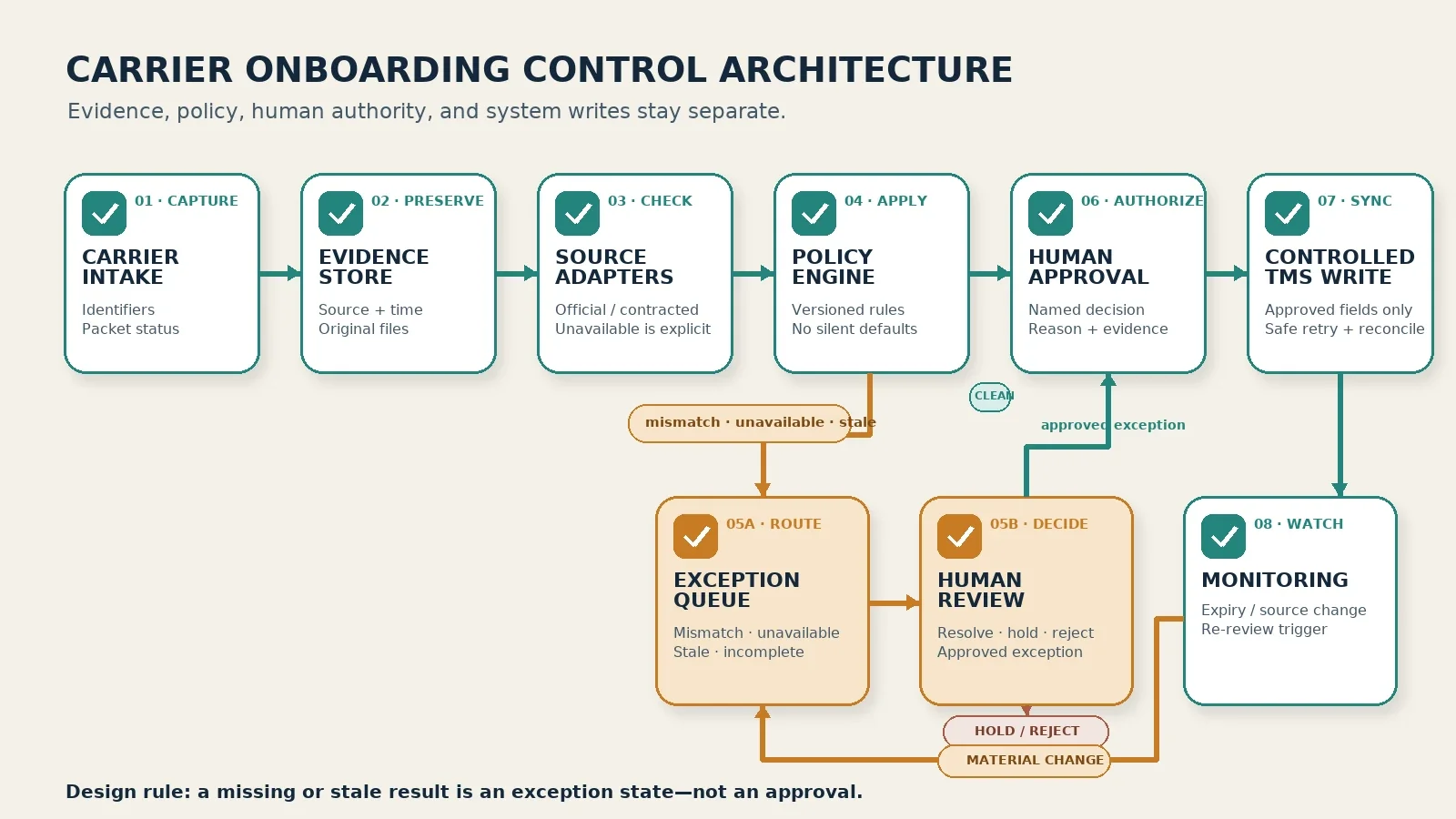
- Intake and identity resolution. Capture the USDOT/MC identifiers and legal-name information. Detect likely duplicates before creating another carrier record.
- Document collection. Request the packet components required by the broker's approved policy. Show what is missing without claiming a document is valid merely because it exists.
- Source adapters. Retrieve permitted data from official or contracted sources. Store the source, retrieval time, relevant value, and response state.
- Policy engine. Apply deterministic rules for required fields, expiry, matching, approval thresholds, and allowed exceptions. Version the policy so an old decision can be understood later.
- Exception queue. Group related mismatches and show the reviewer the underlying evidence. Never hide an unavailable source behind a green status.
- Human decision. Record the approver, decision, reason, evidence snapshot, and any expiry or re-review condition.
- Controlled TMS write. Send only approved fields. Use idempotent operations where the destination supports them, and reconcile failures instead of creating duplicates.
- Post-approval monitoring. Watch applicable expiries and source changes, then route material events to a hold or re-review workflow according to policy.
FMCSA states that insurance requirements vary with entity type, operating authority, cargo, and vehicle type; there is no safe universal rule set for every carrier (FMCSA insurance filing requirements). FMCSA's 2026 system transition also makes adapter ownership important: one current agency notice says the legacy Licensing & Insurance view is limited to historical records and that newer filings are not reflected there (FMCSA L&I notice). Treat external-source behavior as a maintained contract, not a permanent assumption.
Where AI helps—and where it does not
Ordinary software should handle required fields, date comparisons, identifier matching, duplicate prevention, state transitions, permissions, and retry logic. AI may help classify packet documents, extract candidate values, summarize an exception, or suggest a reviewer note. It should not silently decide that a carrier is safe, manufacture a missing value, or convert an unavailable source into an approval.
When electronic W-9 collection is part of the flow, use current IRS requester guidance and qualified tax/legal review. The IRS describes specific requirements for electronic submission systems and substitute forms; a convenient upload field is not automatically an adequate implementation (IRS requester instructions).
Scope, effort, and operational value
Avoid a cost or timeline promise until the source contracts, policy, systems, and exception volume are known. A useful estimate starts with scope units.
| Scope driver | Lower complexity | Higher complexity |
|---|---|---|
| Intake | One carrier type and one packet | Conditional packet by authority, cargo, or operating model |
| Sources | A small number of stable checks | Multiple official/contracted sources with different freshness and access rules |
| Policy | Simple required/blocked/review states | Versioned rules by customer, load type, geography, or risk tier |
| Integrations | One TMS write | Bi-directional TMS, CRM, document, payment, messaging, and monitoring flows |
| Exceptions | Single reviewer queue | Specialist routing, dual approval, service levels, holds, and appeals |
| Evidence | Decision log | Immutable evidence snapshots, retention rules, exports, and audit reporting |
For operational value, calculate time capacity before claiming savings:
Potential monthly hours released = onboarding volume × current manual minutes per application × eligible automation share ÷ 60
Then subtract reviewer time, exception handling, carrier support, software/data fees, maintenance, and implementation effort. Released time is not automatically cash savings or headcount reduction. Validate the model against real queue data after a pilot.
A sensible staged implementation
| Stage | Deliverable | Exit condition |
|---|---|---|
| Baseline | Current-state map and exception taxonomy | The team can explain where applications wait and why |
| Controlled intake | One entry point, required fields, document status | Missing items are visible without email archaeology |
| Verification pilot | Selected source checks and evidence timestamps | False matches, unavailable sources, and reviewer actions are measured |
| Approval control | Rules, queue, roles, reason codes, audit events | No approval bypasses the defined decision gate |
| TMS integration | Approved-field mapping, retry, reconciliation | Duplicate and partial writes are testable and recoverable |
| Monitoring | Expiry/change events and re-review policy | Post-approval changes create the correct operational response |
Use cases that justify different designs
- Growing freight brokerage: prioritize fast carrier self-service, a clear exception queue, and a safe first-write into the TMS.
- Enterprise 3PL: prioritize multiple business units, policy versions, role separation, exportability, monitoring, and reporting.
- Specialized freight operation: prioritize equipment, commodity, insurance, permit, or customer-specific conditions defined by qualified reviewers.
- TMS provider: prioritize tenant isolation, configuration boundaries, webhook/API contracts, and customer-owned policy.
- Low-volume brokerage: a configured SaaS workflow or better checklist may outperform a custom build.
Choose it when—or avoid it
Choose carrier onboarding automation when the workflow is repeatable, source checks are defined, volume creates queue pressure, and the organization can name the owner of each exception. It is particularly useful when the same approved data must reach a TMS, CRM, payment process, and monitoring queue without re-entry.
Avoid a custom platform when a standard product already fits, the policy is undocumented, source access is uncertain, or exceptions require judgment in nearly every case. Also avoid AI-first scope when deterministic rules and ordinary workflow configuration can solve the problem more transparently.
Risks and exception controls
| Failure mode | Unsafe behavior | Better control |
|---|---|---|
| Duplicate carrier identity | Create another record from a name variation | Resolve on stable identifiers and send uncertain matches to review |
| Source timeout | Treat no response as no issue | Mark unavailable, hold or apply the approved fallback, and log the event |
| Stale evidence | Reuse a prior green result indefinitely | Store retrieval time and enforce recheck rules |
| Conflicting legal names | Accept the packet because all files exist | Compare authoritative and submitted fields; require resolution evidence |
| Extracted document error | Write model output directly to the TMS | Validate type/format, show the source region, and require review below threshold |
| Approval override | Let any user bypass a rule | Restrict permission, require reason, preserve evidence, and report overrides |
| Partial TMS write | Retry blindly and create duplicates | Use idempotency where possible plus reconciliation and repair queues |
| Post-approval change | Leave the carrier active without review | Trigger the policy-defined hold, warning, or re-approval workflow |
Illustrative workflow—not a client case study
Consider a hypothetical brokerage whose carrier-relations team receives a packet. The intake resolves the USDOT identifier, collects required files, and checks approved sources. The legal name differs between the submitted tax document and the carrier record, while one external source is temporarily unavailable. The rules engine does not approve the carrier. It creates one consolidated exception containing both issues, pauses the TMS write, and assigns a reviewer. After the team resolves the name mismatch and the source responds, an authorized reviewer records the decision and releases the approved fields.
The value in this example is not an invented speed metric. It is a controlled state: everyone can see what is missing, why the carrier is on hold, who can decide, and what will happen next.
Technical perspective: The hardest part is not the carrier form. It is maintaining trustworthy boundaries between submitted data, source evidence, policy, exceptions, human authority, and downstream system writes.
If your team is comparing tools or planning a TMS connection, discuss the current workflow and integration requirements before choosing what to build.
How to evaluate a provider
Ask every software or implementation provider to demonstrate:
- Which sources are used, what each source can and cannot prove, and how freshness is shown.
- What happens during timeouts, data conflicts, source transitions, and webhook failures.
- How rules are configured, versioned, tested, approved, and rolled back.
- How reviewer permissions, overrides, reason codes, and evidence retention work.
- How carrier data is exported and who owns documents, decisions, and audit records.
- How the TMS integration prevents duplicate or partial records and reconciles failures.
- Which tasks use AI, which use deterministic rules, and how extraction errors are surfaced.
- What support, monitoring, security review, and change management are included after launch.
A polished demo of the happy path is not enough. Request an exception-path demonstration using your actual policy and systems.
How Technanosoft approaches carrier onboarding automation
Technanosoft's verified service pages describe custom workflow systems, portals, dashboards, API integrations, document handling, routing, role-based access, human approvals, audit logs, QA, cloud deployment, and post-launch support. Applied to carrier onboarding, that means starting with the operational decision—not assuming a custom platform or an AI model is the answer.
The discovery work should map the intake channels, packet components, source checks, policy owners, reviewer roles, exception types, TMS fields, monitoring events, and evidence requirements. The next step may be a configured SaaS tool, a focused integration layer, a carrier portal, or a custom approval service. Existing products should remain in place where they solve the requirement well.
For a build or integration, the architecture should separate source adapters from policy, keep uncertain states visible, and test the full failure path before go-live. AI document extraction can be added when it reduces repetitive review without hiding uncertainty. Deterministic validation, permissions, human approval, audit events, reconciliation, monitoring, and support remain the control layer.
This is a service approach, not a claim that Technanosoft has already delivered this exact workflow for a named carrier or broker. The appropriate first engagement is to review the real process, integrations, constraints, and smallest useful release.
Frequently asked questions
What is carrier onboarding automation?
It is software that coordinates carrier intake, document collection, source checks, policy rules, exception review, approval records, downstream system updates, and applicable monitoring. It should make the decision process more consistent and visible, not simply turn a packet into an automatic approval.
Which carrier onboarding steps should remain human-reviewed?
Review is appropriate for identity conflicts, unusual authority or insurance states, document discrepancies, payment changes, policy overrides, inconclusive source results, and any decision your legal, safety, insurance, or compliance teams classify as sensitive. The software should make those cases easier to inspect and document.
Should we build or buy carrier onboarding software?
Buy when the workflow and integrations are standard. Integrate when a product covers verification or collection but not your approval or TMS flow. Build when the unique policy and operating model are durable enough to justify ownership. Low volume or unstable policy may justify improving the manual process first.
Can AI approve a carrier automatically?
AI can assist with document classification, field extraction, or exception summaries, but it should not be treated as independent proof of identity, authority, insurance, safety, or policy fit. Use approved sources, deterministic rules, and human authority for sensitive or uncertain decisions.
How should carrier onboarding connect to a TMS?
Define which system owns every field. Send only approved data, preserve the evidence and decision outside the TMS if needed, make retries safe, and reconcile partial failures. A carrier record should not become active merely because an integration request succeeded.
What happens after a carrier is approved?
The system should apply the organization's monitoring policy: track relevant expiries or source changes, route material events to a reviewer, and update holds or statuses in connected systems. Approval is a state with conditions, not the end of the data lifecycle.
How much does carrier onboarding automation cost?
A defensible estimate needs the intake variants, source contracts, policy complexity, integrations, roles, exception volume, evidence retention, security requirements, and support model. Without those inputs, a fixed range would be guesswork. Start with a workflow and architecture scope, then price the chosen buy, integrate, or build path.
The decision in one minute
If standard software covers your packet, checks, monitoring, and TMS connection, buy it. If the verification layer works but your policy or systems differ, integrate it. Build only when the unique workflow is strategically important and your team is prepared to maintain sources, rules, exceptions, security, and support.
Whichever path you choose, require five things: source timestamps, explicit unavailable states, human exception authority, controlled downstream writes, and post-approval monitoring. Those controls matter more than a fast happy-path demo.
Review your carrier onboarding workflow and integration requirements with Technanosoft.
Public author/reviewer profile and publication dates remain pending editorial approval. Public publication has not been performed.