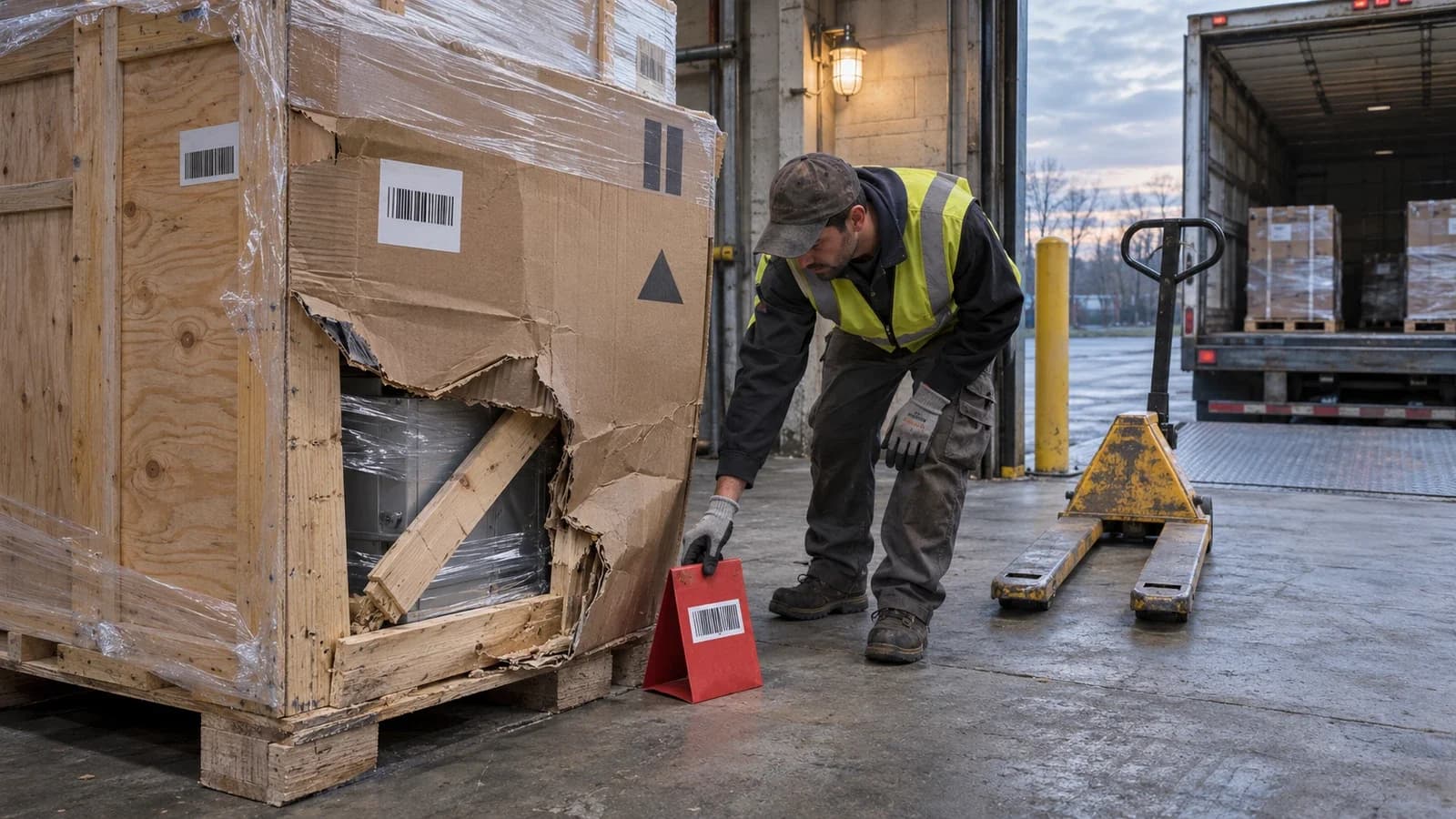
Technanosoft Insights
Bill of Lading Automation: Workflow, Controls, and Build-vs-Buy
A decision-first guide to BOL document processing and electronic BOL integration, with build-vs-buy criteria, exception controls, and a practical implementation path.

A decision-first guide to BOL document processing and electronic BOL integration, with build-vs-buy criteria, exception controls, and a practical implementation path.
LOGISTICS SOFTWARE
Bill of lading automation should capture or create shipment data, validate it against the right business records, route discrepancies to a person, and synchronize only approved data with the transportation management system (TMS), warehouse management system (WMS), or enterprise resource planning system (ERP). The first decision is whether you need document-processing automation, a standards-based electronic BOL exchange, or both.
Draft for internal editorial review · Approximately 14 minutes

Quick answer
Bill of lading automation replaces repeated document handling with a controlled workflow: ingest or create the BOL, identify the shipment, extract or map fields, validate them, send uncertain or conflicting items to human review, preserve the evidence, and update connected systems. Buy when a standard product fits. Integrate when the capture or eBOL platform is suitable but your TMS, rules, or approval process differ. Build only when the unique workflow and long-term ownership justify it.
Key takeaways
| Decision | Practical answer |
|---|---|
| Define the scope first | PDF capture, BOL creation, and transferable eBOL issuance are different problems |
| Best default | Buy the commodity capability and integrate it with your system of record and exception workflow |
| Keep human control over | Low-confidence extraction, cross-record conflicts, unusual freight details, rejected states, and release decisions |
| Use AI selectively | Propose document type and candidate fields; use rules for required data, states, permissions, and writes |
| Design for failure | Duplicate messages, unavailable integrations, stale drafts, rejected requests, and partial writes need explicit states |
On this page
- Who this guide is for
- What bill of lading automation means
- Buy, integrate, build, or keep the current process
- Six planning questions
- Workflow and architecture
- Implementation scope and value
- Use cases
- Choose it when—or avoid it
- Risks and exception controls
- Provider selection
- Technanosoft's approach
- FAQs
- The decision in one minute
Who this guide is for
This guide is for a US logistics operations or technology leader who receives BOLs through email, portals, scans, or partner systems; sees repeated rekeying or mismatch resolution; and needs a defensible plan for automation. It is not legal advice. BOL requirements, negotiability, title-transfer effects, and electronic-record recognition depend on the mode, jurisdiction, contract, and participating parties; qualified legal and operational teams must approve those decisions.
What bill of lading automation means
Bill of lading automation covers two related but different lanes.
Document-processing automation starts with a PDF, image, email attachment, or uploaded file. The system classifies the document, extracts candidate fields, compares them with shipment records, routes exceptions, and stores the approved data and original evidence. Infor's current inbound BOL documentation illustrates this pattern: configured email or folder intake leads to extraction and validation, while extraction failure or a non-BOL document becomes an explicit exception for review (Infor inbound BOL process).
Electronic BOL exchange creates and manages structured records between trading partners. For US less-than-truckload (LTL) workflows, the NMFTA Digital LTL Council describes eBOL API version 2.1 as a framework for creating, transmitting, and managing BOL data (Digital LTL Council). Container shipping has a separate DCSA Bill of Lading standard covering shipping instructions, draft transport documents, corrections, approval, issuance, amendment, and surrender (DCSA adoption guide).
Digitizing a PDF does not automatically create a legally transferable electronic original. Choose the lane—and the governing standard—before selecting software.
Why manual BOL handling breaks down
| Current problem | Operational effect | Useful software response |
|---|---|---|
| BOLs arrive through several channels | Documents are missed or attached to the wrong shipment | One intake layer with shipment resolution and duplicate checks |
| Staff rekey header and line data | Transcription errors and delayed downstream updates | Candidate extraction plus field-level validation |
| Formats and scans vary | Happy-path templates fail silently | Document classification, confidence signals, and review queues |
| BOL data conflicts with an order or receipt | Teams choose a value without preserving the reason | Cross-record rules, evidence view, and reason-coded decisions |
| A partner API accepts work asynchronously | “Accepted” is mistaken for completed | State tracking, correlation, notifications, and reconciliation |
| A downstream write partly fails | TMS, WMS, ERP, and archive disagree | Idempotent operations where supported and a repair queue |
Buy, integrate, build, or keep the current process?
For most teams, integrate is the practical default. A document-processing or eBOL product can provide the commodity layer, while your integration owns shipment matching, business rules, human review, and system-of-record updates. Building every extractor, standard adapter, document store, and review screen from zero creates continuing maintenance that may not differentiate the business.

| Path | Choose it when | Main trade-off | Proof to request |
|---|---|---|---|
| Buy | One product fits the document types, partner network, review process, and target systems | Faster adoption but less control over workflow and data ownership | Real documents, exportability, exception behavior, roles, support, and integration limits |
| Integrate | A product handles capture or exchange, while your rules and downstream systems need adaptation | More interfaces and failure states to operate | API/webhook versioning, correlation, retry rules, reconciliation, and field ownership |
| Build | The process, data model, user roles, or partner network is materially unique and durable | Highest engineering, security, conformance, and support responsibility | Standard access, test environments, exception corpus, operating owner, and maintenance budget |
| Keep the current process | Volume is low, exceptions dominate, or the target workflow is still changing | Manual effort remains, but premature software is avoided | Baseline workload and a measurable trigger for revisiting automation |
Do not select a product from an extraction demo alone. Ask what happens when two BOLs match one shipment, a field is missing, a partner rejects the request, a webhook is delivered twice, or the destination system is unavailable.
Six planning questions
Use these as a draft planning framework, not as a claimed proprietary methodology.
- Workflow: Does the process receive a BOL, create one, exchange structured data, manage an electronic original, or combine these jobs?
- Users: Who can submit, correct, approve, issue, reject, cancel, amend, surrender, or repair a record?
- Data: Which fields are authoritative in the order, shipment, carrier, BOL, receipt, and invoice? How are line items and references matched?
- Integrations: Which TMS, WMS, ERP, carrier API, eBOL platform, document store, identity service, and notification channel participates?
- Intelligence: Can deterministic mapping and rules solve the problem? Where would document classification or extraction add value, and what confidence is acceptable?
- Control: Which condition creates an automatic pass, warning, hard stop, human review, partner response, rollback, or reprocessing task?
This prevents an expensive scope error: buying “BOL automation” before deciding which BOL transaction the organization is actually trying to control.
Workflow and architecture
The architecture should preserve five boundaries: source document, structured candidate data, validation decision, human authority, and downstream write. An asynchronous acceptance is not the same as business completion.
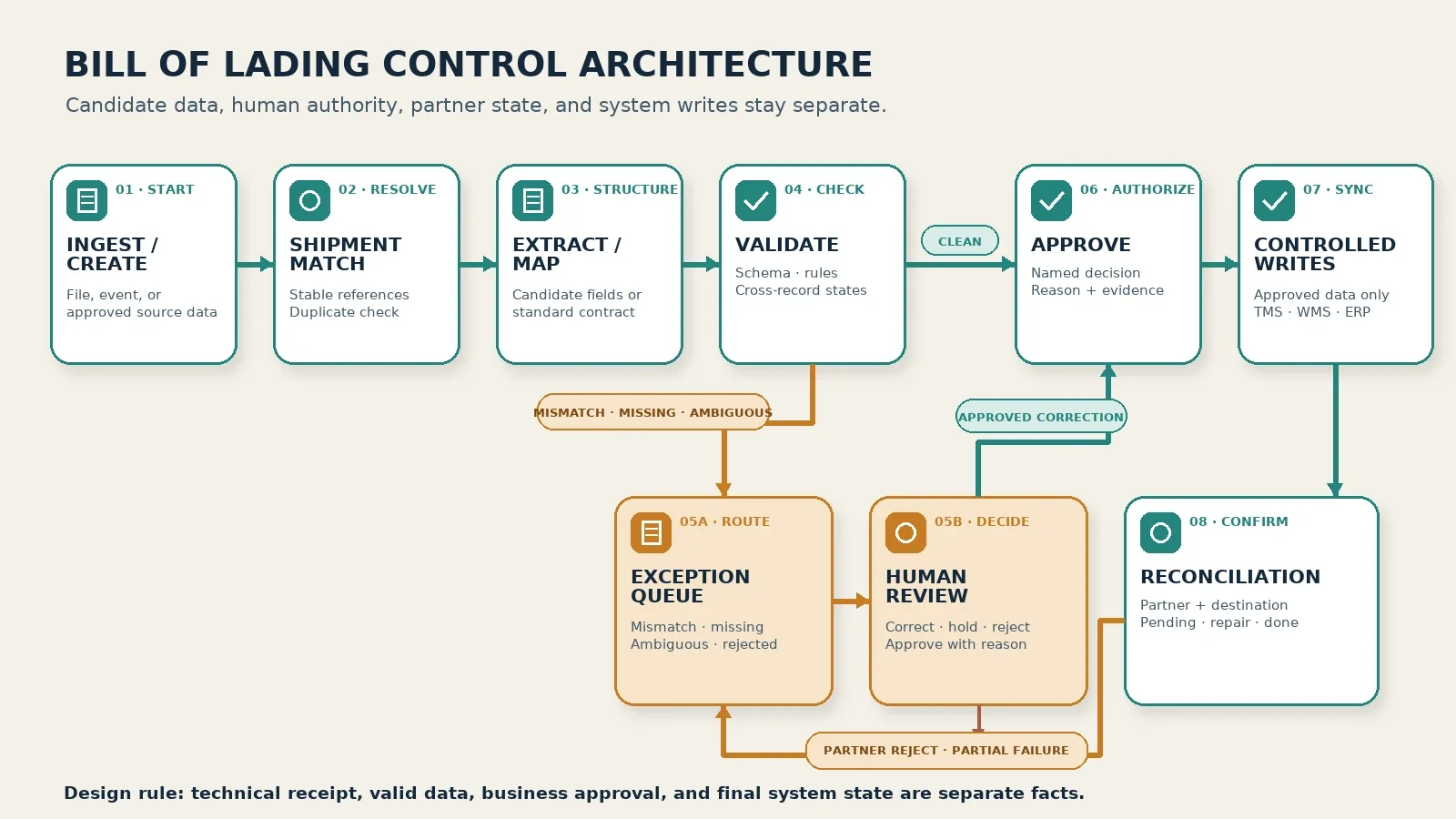
- Ingest or create. Receive a file/event or start from approved shipment data. Assign a correlation key before processing.
- Resolve the shipment. Match stable references and detect duplicates. Do not attach a plausible document to the wrong load automatically.
- Extract or map. For files, produce candidate fields with source locations and confidence. For APIs, map the correct standard version and partner contract.
- Validate. Apply schema, required-field, format, cross-record, state, and business-rule checks. Keep “not available” distinct from “valid.”
- Review exceptions. Group related mismatches, show the original evidence, restrict edits, and record the decision reason.
- Approve and write. Only an approved record updates the TMS, WMS, ERP, archive, or partner workflow. Preserve who or what authorized the transition.
- Reconcile. Track callbacks, rejections, timeouts, duplicate events, and partial destination failures until the systems agree or a person owns the repair.
- Monitor change. Reprocess only under a defined rule when a document, shipment, partner response, or standard version changes.
DCSA's current issuance guidance separates synchronous technical acknowledgement from asynchronous business responses and routes regular responses and business rejections to the appropriate workflow; other technical failures go to investigation (DCSA issuance implementation guide). That is a useful general design lesson even when a different mode or standard applies: transport success, schema validity, business acceptance, and final state are separate facts.
Where AI helps—and where it does not
AI may help identify a document type, extract candidate fields from changing layouts, read line items, or summarize a mismatch for a reviewer. Ordinary software should still own schema validation, required fields, identifiers, duplicate control, state transitions, permissions, partner contracts, and system writes.
Do not let a model manufacture a missing value, silently choose between conflicting records, or turn confidence into legal or operational approval. Where a rules-based template or configured SaaS extractor handles the known document set reliably, an AI layer may add cost and review work without improving the decision.
Implementation scope and value
Cost and timeline are not defensible until the document corpus, operating mode, partner contracts, target systems, and exception rate are known. Estimate from scope units rather than an unsupported market range.
| Scope driver | Lower complexity | Higher complexity |
|---|---|---|
| Input | One clean PDF type | Email, scan, mobile photo, API, EDI, and multiple standards |
| Data | Header fields | Line items, hazardous goods, accessorials, references, and amendments |
| Validation | Required fields and format | Cross-order, carrier, receipt, contract, and invoice rules |
| Integration | One outbound TMS update | Bidirectional TMS/WMS/ERP, partner APIs, archive, and notifications |
| Exceptions | One review queue | Specialist routing, dual approval, partner rejection, repair, and appeals |
| Operations | Manual replay | Versioned contracts, monitoring, conformance tests, and recovery tooling |
For a transparent workload baseline:
Potential monthly hours released = monthly BOL volume × current manual minutes per BOL × eligible automation share ÷ 60
Then subtract review time, exception handling, partner support, software/model fees, maintenance, and implementation effort. Time released is capacity, not automatically cash savings or reduced headcount. Measure the real baseline and pilot exception rate before making an investment claim.
A sensible staged implementation
| Stage | Deliverable | Exit condition |
|---|---|---|
| Baseline | Document/channel inventory and exception taxonomy | The team can explain where BOL work waits and why |
| Controlled intake | Correlation, duplicate checks, original evidence | Every item has a shipment candidate and visible status |
| Extraction or API pilot | One document family or one partner flow | Required fields, failures, and human corrections are measured |
| Validation control | Rules, review roles, reason codes, audit events | No uncertain record bypasses the decision gate |
| System integration | Approved writes, callbacks, retries, reconciliation | Duplicate and partial failures are testable and recoverable |
| Operational rollout | Monitoring, support, change process, ownership | Standard and partner changes have an accountable response |
Use cases
- Inbound receiving: read BOLs arriving by email or folder, match them to purchase orders or appointments, and route quantity or reference conflicts before WMS updates.
- LTL shipping: exchange structured eBOL data with a carrier using the applicable NMFTA Digital LTL standard and the partner's supported implementation.
- Warehouse check-out: generate a BOL from approved appointment/shipment data, capture the required acknowledgement or signature, and return the resulting document to the source system. Opendock's current eBOL guide shows this appointment-completion pattern with webhooks and signed document return (Opendock eBOL guide).
- Container shipping: manage shipping instructions, draft review, approval, issuance, amendment, and surrender through the applicable DCSA modules and an approved eBL solution-provider arrangement.
- Freight audit preparation: compare approved BOL data with shipment, receipt, and invoice records—but keep invoice audit rules and payment approval as separate controlled processes.
Choose it when—or avoid it
Choose BOL automation when volume creates repeated work, the document or exchange states are defined, the source systems can expose stable identifiers, and the organization can name the owner of every exception. It is especially useful when approved BOL data must reach several systems without re-entry.
Avoid a custom build when a configured product already supports the document family, standard, partner network, and destinations. Also avoid automation when the process lacks authoritative source data, nearly every item requires judgment, or the legal model for an electronic original is unresolved. A better intake checklist, a standard SaaS product, or a narrower integration may be the correct first step.
Risks and exception controls
| Failure mode | Unsafe behavior | Better control |
|---|---|---|
| Duplicate document or event | Create another shipment record | Correlation key, content fingerprint, idempotency where supported, and duplicate review |
| Wrong shipment match | Attach the nearest reference automatically | Require stable identifiers; route ambiguous matches to a person |
| Low-confidence extraction | Write candidate data directly to the TMS | Validate fields and show the source region before approval |
| Conflicting quantity or weight | Let the last system win | Define field ownership and require a reason-coded resolution |
| API acknowledgement | Treat a technical 2xx as final business completion | Track asynchronous state and the documented business response |
| Partner or destination outage | Retry forever or lose the item | Bounded retry, dead-letter/repair queue, alert, and reconciliation |
| Standard or partner change | Continue sending an obsolete contract | Version adapters, run conformance/regression tests, and stage rollout |
| Electronic original misunderstood | Treat a scanned PDF as transferable title | Use the approved legal/platform process for the relevant mode and jurisdiction |
Illustrative workflow—not a client case study
Consider a hypothetical 3PL receiving an emailed BOL for a warehouse appointment. The system identifies the file as a BOL, extracts the shipment reference, carrier, pieces, weight, and line details, and matches the reference to the appointment. The piece count agrees, but the weight conflicts with the current shipment record and one line is unreadable.
The workflow does not overwrite the TMS. It creates one exception containing the source image, candidate fields, conflicting system values, and the validation rules. A reviewer confirms the unreadable line, investigates the weight difference, records a reason, and approves the corrected data. The system writes the approved values, stores the original evidence and decision, and confirms that the destination accepted the update.
The value is not an invented accuracy or speed metric. It is a controlled state: the team knows what disagreed, who decided, which evidence supported the decision, and whether the connected systems now agree.
Technical perspective: The difficult part is not reading a document. It is preserving the boundary between source evidence, candidate data, business rules, human authority, partner state, and downstream writes.
If your team is comparing capture tools or planning an eBOL/TMS connection, discuss the workflow and integration requirements before deciding what to build.
How to evaluate a provider
Ask each software or implementation provider to demonstrate:
- Which document types, modes, standard versions, and partner implementations are supported—and what is not.
- How original files, extracted values, field provenance, edits, and decisions are retained and exported.
- What happens with a duplicate, ambiguous shipment match, missing field, conflicting value, rejected business response, or unavailable destination.
- How API/webhook authentication, versioning, correlation, retries, replay, and reconciliation work.
- Which steps use AI, which use deterministic rules, and how confidence and reviewer corrections are measured.
- How roles, approvals, overrides, reason codes, audit events, retention, and customer data separation work.
- Who owns conformance testing, partner onboarding, support, standard changes, and post-launch monitoring.
- How you can leave the product without losing documents, structured data, or decision evidence.
A polished happy-path extraction is not enough. Request an exception-path demonstration using representative documents and the target systems.
How Technanosoft approaches bill of lading automation
Technanosoft's current custom software development service describes workflow systems, portals, API-based platforms, document extraction with review queues, routing, roles, integrations, QA, and post-launch support. Applied to BOL automation, that means beginning with the controlled transaction—not assuming a custom platform or AI model is the answer.
Discovery should map the BOL types, modes, channels, states, users, authoritative fields, partner contracts, and exception owners. The architecture should then place the boundary between a packaged extractor or eBOL platform and the organization's rules, approval, evidence, and systems of record. A first release can be deliberately narrow: one document family or partner, one destination, a visible exception queue, and a reconciliation report.
AI should be added only where unstructured documents justify it. Required fields, state transitions, permissions, duplicate protection, and writes remain explicit software controls. The rollout should test representative failures—not only clean documents—and assign ownership for monitoring and contract changes.
This is a service approach, not a claim that every organization needs custom development. If a standard product covers the workflow and integrations, configuring it may be the better decision. If the gap is durable, Technanosoft can help plan the workflow, integration boundary, review experience, and controlled first release.
Frequently asked questions
Is BOL data extraction the same as an electronic bill of lading?
No. Extraction turns a document image or PDF into candidate structured data. An electronic BOL workflow creates, exchanges, approves, issues, and may transfer or surrender a structured transport document under a defined standard, platform, contract, and legal framework. A scanned PDF may support operations, but it does not automatically have the effect of a transferable electronic original.
Which BOL fields can be automated?
Candidate fields may include BOL and shipment references, shipper and consignee, carrier, dates, locations, pieces, packaging, weight, freight details, references, and line items. The safe set depends on the mode, document, standard, destination schema, and business rules. Start with fields that have authoritative comparison data and a clear exception owner.
Does bill of lading automation require AI?
No. Structured eBOL exchange, mappings, required-field checks, state transitions, and integrations are ordinary software problems. AI can help with variable PDFs, scans, handwriting, or line-item extraction, but a rules-based template or existing SaaS product may be simpler for stable document layouts.
Should we buy BOL software or build it?
Buy when a product supports the relevant documents or standard, partner network, review process, and target systems. Integrate when the commodity layer fits but your rules or destinations differ. Build when the unique workflow, ownership needs, scale, or partner model creates a durable reason to maintain software and conformance work.
How should BOL automation connect to a TMS or WMS?
Define the system of record for each field, match stable shipment identifiers, send only approved data, and make duplicate or partial operations recoverable. Track asynchronous partner responses separately from the destination write. A reconciliation view should show items accepted, pending, rejected, failed, or waiting for human action.
How do we estimate ROI without inventing savings?
Measure monthly volume, current handling minutes, eligible automation share, reviewer time, exception rate, correction effort, software and model fees, support, and implementation cost. Treat released hours as capacity until finance confirms a cash effect. Pilot representative documents and failures before applying the result to the full volume.
What should the first release include?
Choose one BOL family or partner flow, one destination, stable shipment matching, explicit validations, a human exception queue, original evidence, approved writes, and reconciliation. Defer broad partner coverage and advanced AI until the team understands real exception behavior.
The decision in one minute
| If your situation is… | Consider… |
|---|---|
| Staff rekey PDFs into one system | Configure a document-processing product and controlled review workflow |
| An extractor fits but your TMS process differs | Integrate the product with your rules, approval, and reconciliation |
| LTL partners support a common eBOL contract | Implement the applicable NMFTA partner flow and test real exceptions |
| Container-shipping parties need eBL lifecycle support | Use the applicable DCSA modules and approved platform/legal arrangement |
| The workflow is low-volume or policy is changing | Improve intake and measurement before automating |
| The process and partner model are genuinely unique | Evaluate a focused custom build with long-term operating ownership |
Start by naming the transaction, standard, system of record, and exception owner. That decision is more important than choosing an OCR model or drawing a large platform architecture. A useful first release creates a trustworthy handoff for one bounded flow; it does not pretend every BOL, partner, and legal scenario is already solved.
Have a BOL workflow you are trying to improve? Review the current documents, states, exceptions, and integration requirements with Technanosoft to plan a practical first release.
Related Technanosoft reading
- AI workflow automation services
- Fleet management software and development considerations
- Logistics app development guide
Public author profile, reviewer, publication date, and final CMS related-article presentation are pending editorial approval and release checks.