Technanosoft Insights
Warehouse Slotting Software: Demand, Constraints, and Reslotting Controls
A decision-first guide to warehouse slotting data, location constraints, replenishment trade-offs, controlled reslotting, WMS integration, and buy-versus-build choices.

A decision-first guide to warehouse slotting data, location constraints, replenishment trade-offs, controlled reslotting, WMS integration, and buy-versus-build choices.
Warehouse slotting software recommends where products should be stored and picked inside a warehouse. The difficult part is not ranking fast movers. It is choosing locations that respect demand, unit of measure, physical capacity, product and site constraints, replenishment workload, congestion, automation, and the cost of moving inventory—then turning an approved recommendation into traceable warehouse work.
Editorial draft: November 19, 2026 · Estimated reading time: 14 minutes
Quick answer
Choose warehouse slotting software around the complete operating cycle, not only the shortest theoretical pick path. Build a reliable item-location model, define hard constraints before optimization goals, keep the recommendation separate from the physical move, and connect reslotting to WMS replenishment and inventory controls. Start with one pick area and one order profile. Measure travel, touches, replenishment, congestion, exceptions, execution accuracy, and service together before expanding.
Key takeaways
| Question | Decision-first answer |
|---|---|
| Is the nearest slot always best? | No. A nearby slot can create excessive replenishment, congestion, unsafe handling, poor cube use or an incompatible pick method. |
| What data matters most? | Demand by order profile, item and pack dimensions, unit of measure, location capacity, operational constraints, and replenishment behavior. |
| Is slotting the same as putaway? | No. Slotting decides preferred placement; putaway directs a particular receipt or movement under current inventory and warehouse rules. |
| Should a recommendation move stock automatically? | Not by default. Validate constraints, inventory state, open work and operational timing before creating controlled movement tasks. |
| Buy, extend or build? | Buy mature optimization when the warehouse fits supported models; extend WMS when it owns location and work; build only the distinctive data, rules or orchestration layer. |
On this page
- Who this guide is for
- What slotting software actually decides
- Why closest is not always best
- Build a six-input slot contract
- Separate recommendation from movement
- Plan replenishment and overflow
- Map system ownership
- Choose buy, extend or build
- Pilot a bounded area
- FAQs
Who this guide is for
This guide is for distribution-center, fulfillment, 3PL, retail, manufacturing, warehouse, supply-chain, operations, product, data and technology leaders evaluating slotting, reslotting or inventory-placement capability.
It is not an ergonomics, occupational-safety, fire-code, food-safety, hazardous-material, labor, engineering or legal standard. A site's responsible owners must define and approve access, load, compatibility, equipment, handling, temperature, regulatory and worker-safety constraints before software recommends or releases movement.
What warehouse slotting software actually decides
Slotting software evaluates which item or unit of measure should occupy which eligible location for a defined period or order profile. Depending on scope, it may:
- consolidate demand by SKU, pack, order type, channel or wave;
- classify item velocity, variability, affinity and seasonality;
- validate location type, dimensions, capacity and equipment compatibility;
- compare travel, replenishment, congestion and space objectives;
- preserve fixed, dedicated, regulated or otherwise constrained locations;
- propose moves between reserve, forward-pick and other areas;
- stage recommendations for review and approval;
- create or export controlled movement or replenishment work;
- record execution, exceptions and reversals; and
- compare the expected effect with actual operation after the move.
Microsoft's warehouse-slotting documentation describes a progressive process: generate demand, locate that demand, review a slotting plan, and then create replenishment work. SAP describes slotting as a way to determine storage parameters from product, storage, packaging and demand data. Those details differ by platform, but they support a durable control principle: a model recommendation is not yet a physical warehouse fact.
Slotting, putaway and replenishment are related but different
| Capability | Primary question | Typical output |
|---|---|---|
| Slotting | Where should this item or pack ideally live for the planning horizon? | preferred location, location class or move recommendation |
| Putaway | Where should this specific received inventory go now? | executable warehouse task to a valid destination |
| Replenishment | When and how should reserve inventory refill a pick face? | movement task based on demand, minimum, capacity or order need |
| Reslotting | Which current placements should change as demand or constraints change? | prioritized set of proposed moves |
Do not collapse these into one opaque “optimization” action. Each has different timing, evidence, ownership and reversal needs.
Why the closest slot is not always the best slot
A fast-moving item near packing can reduce picker travel. If its pick face is too small, however, the warehouse may create repeated replenishment, cross-traffic and stockouts at the face. If the location cannot support the pack, equipment or handling method, the recommendation is invalid even if its travel score is excellent.
Treat slotting as a constrained multi-objective decision.
| Objective | Useful evidence | What can go wrong if optimized alone |
|---|---|---|
| reduce picker travel | order lines, path geometry, pick sequence | congestion and replenishment may rise |
| reduce replenishment | face capacity, demand rate, reserve position | fast movers may occupy excessive prime space |
| improve space use | dimensions, cube, stacking and location capacity | handling becomes slower or incompatible |
| reduce congestion | concurrent work, aisle and station flow | travel distance can shift elsewhere |
| preserve affinity | products frequently ordered together | family grouping can conflict with capacity or handling rules |
| support automation | equipment reach, container, induction and presentation | manual areas or exception paths become worse |
The model should reject infeasible assignments before comparing preferences. Hard constraints—such as a location, equipment or product incompatibility—must not become soft penalties that can be traded away for a shorter path.

Build a six-input slot contract
Before selecting an optimizer, define the contract between each item or pack and each candidate location.

1. Demand profile
Use order-line demand at the granularity the operation needs: each, inner pack, case, pallet, channel, service class, wave, season or promotion. Historical averages alone can hide peaks and new items. Store the source period, forecast version and confidence rather than presenting demand as timeless truth.
2. Item and pack identity
Model the SKU, variant and unit of measure together with physical dimensions, weight, orientation, container, handling characteristics and any approved compatibility classes. A case and an each are not interchangeable slotting units merely because they share an item number.
3. Location capability
Record usable dimensions and capacity, storage or pick method, equipment reach, zone, sequence, active/reserve purpose, fixed-location rules and any site-approved constraints. Keep the measured or configured capacity distinct from current on-hand inventory.
4. Operational path
Represent actual travel and work boundaries: induction, reserve, pick face, consolidation, packing, dispatch, replenishment approach and exception routes. Straight-line distance is not a substitute for aisle direction, barriers, equipment paths or one-way flow.
5. Replenishment behavior
Estimate how often the face would empty under the demand profile, which reserve locations can support it, what quantity can move, when replenishment may run and where conflicting work appears. Oracle documentation illustrates several trigger families, including minimum-capacity, percentage-of-maximum, reactive and order-based replenishment. The correct choice is operation-specific.
6. Change cost and control
Account for the physical move, relabeling or master-data change, open orders, cycle counts, automation configuration, training, blackout windows, verification and rollback. A theoretically better slot may not justify immediate movement if the gain is small or short-lived.
Version all six inputs. When a planner asks why a move was recommended, the system should identify the demand set, item pack, location rules, objectives and model or rule version that produced it.
Separate a slot recommendation from a physical move
The safest architecture uses an explicit boundary between analysis and execution.
Recommendation state
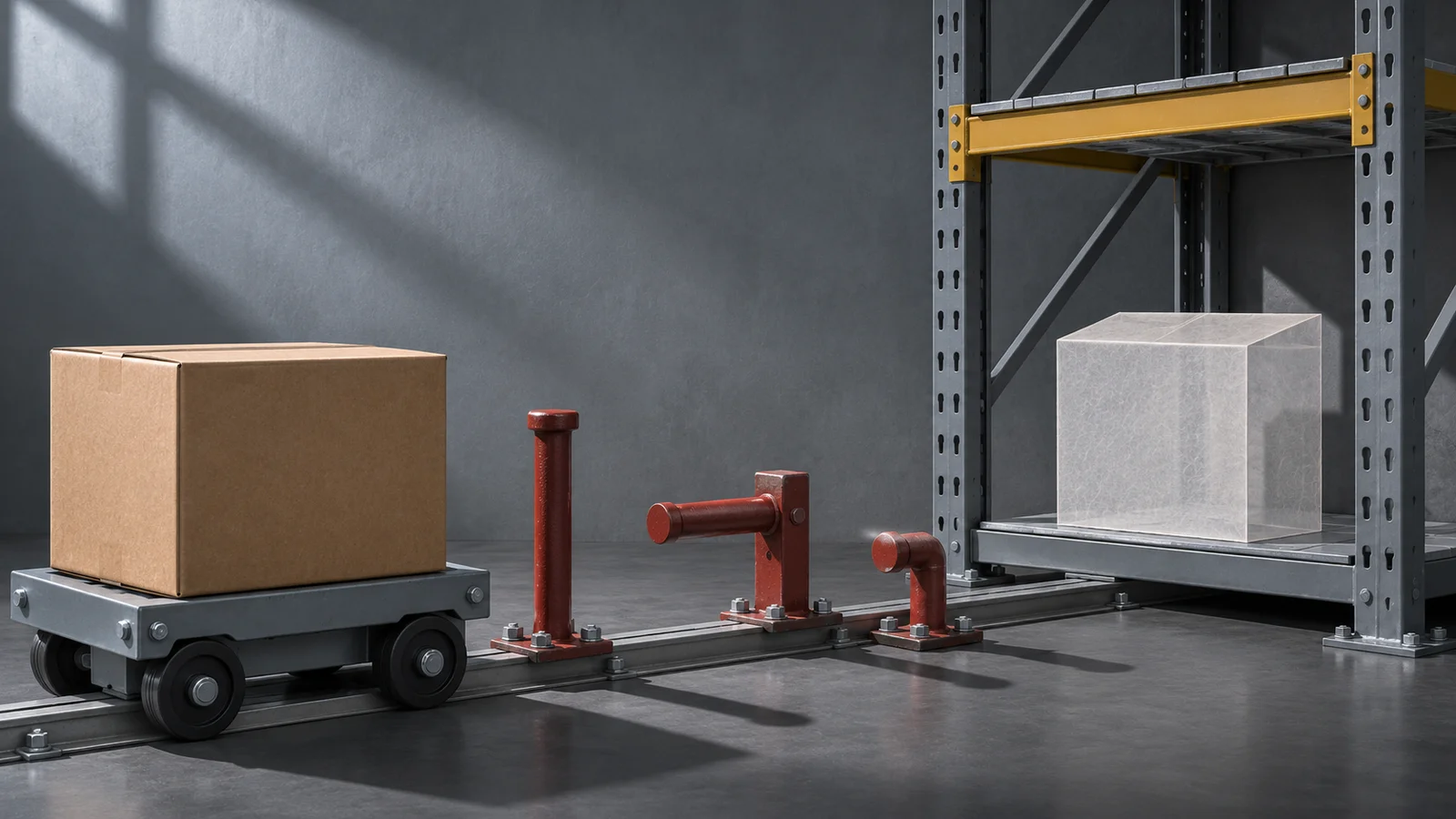
The slotting layer proposes an item, current location, target location, reason, expected operational effect, prerequisite and planning horizon. It can rank moves, simulate scenarios and expose conflicts. It should not claim that inventory already moved.
Validation state
Before work is released, validate current inventory, target capacity, open tasks, reservations, cycle-count status, location blocks, automation configuration, relevant site constraints and the allowed execution window. A recommendation based on yesterday's state can be invalid today.
Execution state
The WMS or responsible work system creates stable movement tasks. Each task needs a source, destination, quantity, unit of measure, inventory identity, status and exception path. Repeated requests must not create duplicate work.
Verification state
Confirm the physical move and location record agree. Preserve partial completion, short quantity, blocked destination, substitute location, abandoned task and reversal as explicit outcomes. Do not mark the recommendation “implemented” because an export succeeded.
Observation state
After a stable operating period, compare actual travel, touches, replenishment, congestion, service and exceptions with the baseline. A recommendation can be logically valid but operationally unhelpful. Feed observed results into review rather than silently rewriting history.
This boundary also keeps human approval meaningful. A planner can approve the objective and move set; the warehouse can still stop an individual task when current physical evidence contradicts the plan.
Plan the pick face, reserve and overflow together
Forward-pick placement is only one part of the decision. Every active slot needs a reserve and exception story.
Ask:
- how much usable inventory fits in the face under the site's approved rules;
- which reserve locations and units of measure can replenish it;
- which demand or threshold creates the task;
- whether replenishment can occur while picking continues;
- how partial cases, residual quantities and mixed inventory are treated;
- what happens when the preferred face or reserve destination is unavailable;
- how overflow is chosen and made visible; and
- how the operation restores the intended state after an exception.
Microsoft's slotting documentation explicitly includes overflow, fixed-location and on-hand considerations. Oracle documentation treats replenishment as its own controlled movement from reserve to active locations. The portable lesson is not to copy either product's configuration. It is to model the entire pick-face cycle before accepting a location recommendation.
Avoid the permanent-reslotting trap
Continuous data does not require continuous physical churn. Set thresholds for material improvement, minimum time in slot, seasonal windows, work capacity and planner review. Group compatible moves into executable batches. Freeze areas during critical operations when required by the site.
Keep a “do nothing” option. If the expected improvement is uncertain, the current slot remains feasible, and move cost is high, observation may be the correct decision.
Map system ownership before integrating
| System | Likely owned facts | Slotting boundary |
|---|---|---|
| OMS / demand planning | orders, forecasts, channels, service classes | demand profile and planning horizon |
| product master / ERP | item, pack, dimensions, unit of measure, compatibility attributes | item-location eligibility inputs |
| WMS | locations, on-hand, reservations, tasks, blocks, execution and inventory history | current physical state and movement work |
| labor / execution system | work queues, resource and congestion context | operational timing and capacity, where approved |
| automation controls | equipment capability, induction, container and routing requirements | machine-compatible location and release constraints |
| slotting layer | objectives, scenario, recommendation, rationale and priority | analysis and proposed moves, not physical truth |
Use stable identifiers for facility, area, location, item, pack and inventory. Preserve source and effective time. Detect missing, stale or contradictory dimensions before optimization. If two systems disagree about location capacity or item pack, route the conflict to an owner instead of choosing the value that makes the solver run.
Do not create a second shadow WMS merely to support analytics. Copy only the planning data needed, retain provenance, and return approved work through supported interfaces. Reconcile task and inventory outcomes after execution.
Choose buy, extend or build
| Option | Choose it when | Watch for |
|---|---|---|
| Buy a dedicated slotting product | the facility needs mature modeling, scenario comparison and repeatable optimization across many items and locations | data preparation, supported constraints, integration depth and how recommendations become work |
| Use or extend the WMS module | the WMS already owns reliable location, inventory and movement data and its slotting model fits the operation | configuration limits, upgrade-safe extension, black-box scoring and cross-system demand inputs |
| Build a focused planning layer | distinctive order profiles, equipment, constraints or approval workflows create real advantage | rebuilding mature solvers, WMS transactions or warehouse controls unnecessarily |
| Combine a product with custom orchestration | optimization is commodity but data contracts, approvals and execution span several systems | unclear ownership, duplicate tasks and unsupported point-to-point integration |
Evaluate products with real scenarios, not a clean heatmap alone. Include new items, missing dimensions, sudden demand, constrained locations, overflow, partial inventory, fixed slots, open tasks, a blocked target, stale recommendations and rollback. Ask which objectives and constraints are configurable, which are merely reported, and what evidence is preserved for each move.
Pilot one area and one order profile
Choose a bounded pick area with reliable item and location data, an understandable demand pattern, known owners and reversible moves. Avoid starting with every warehouse, automation zone, season and item family.
Stage 1: establish the baseline
Measure the current layout and workflow. Validate dimensions, units of measure, location capacity and actual paths. Record travel, touches, face stockouts, replenishment, congestion, exceptions and service under the selected order profile.
Stage 2: run recommendations without movement
Generate proposed slots and review infeasible or surprising results with warehouse owners. Trace each recommendation back to the six-input contract. Correct data and rule gaps before tuning weights.
Stage 3: approve a small move set
Select moves with clear rationale, stable demand and manageable execution. Freeze the exact recommendation set, validate current state, schedule the work and preserve a rollback path.
Stage 4: execute and reconcile
Create movement tasks through the responsible system. Confirm quantity, inventory identity and target. Record partial, blocked and substituted moves. Reconcile location records with physical verification.
Stage 5: observe before expanding
Compare the same measures with the baseline over a suitable operating period. Separate layout effects from unrelated volume, staffing, process or equipment changes. Expand only when the data, execution controls and observed result are credible.
Measure actual operation without inventing a business case:
- pick travel and touches by comparable order profile;
- pick-face stockouts and replenishment frequency;
- congestion or conflicting work in affected areas;
- movement tasks created, completed, excepted and reversed;
- recommendation age at execution;
- dimension, capacity and unit-of-measure data exceptions;
- service, accuracy and order-completion effects; and
- duration and effort required to maintain the slotting model.
Do not call the pilot successful because the optimizer produced a lower score. Success is a feasible, executed and reconciled change that improves the selected operational measures without degrading the controls that matter.
Common warehouse slotting software mistakes
| Mistake | Consequence | Better approach |
|---|---|---|
| ranking only by SKU velocity | replenishment, capacity and compatibility problems move elsewhere | optimize the full item-location contract |
| trusting unverified dimensions | infeasible slots and failed work | validate item, pack and usable location measurements |
| using straight-line distance | path and congestion reality is ignored | model actual warehouse movement boundaries |
| making every rule a soft score | invalid assignments can win mathematically | reject hard-constraint violations first |
| sending recommendations straight to execution | stale state creates duplicate or impossible tasks | revalidate and create controlled WMS work |
| reslotting too frequently | operational churn consumes the expected gain | use materiality, stability and execution thresholds |
| measuring only travel | service or replenishment can worsen unseen | use a balanced operational scorecard |
| hiding the rationale | planners cannot challenge bad data or rules | preserve inputs, versions and reason for every move |
How Technanosoft would approach the workflow
Technanosoft's public logistics and custom-software positioning emphasizes workflow-first discovery, admin controls, integrations, reporting, roles and exception handling. For warehouse slotting, that capability is relevant around data contracts, planning workbenches, approval flows, WMS integration, execution checkpoints and operational reporting.
A responsible engagement would begin with one facility area and order profile. The team would map item and location data, identify system owners, distinguish hard constraints from optimization preferences, define how approved recommendations create WMS work, and test reconciliation before enabling a wider rollout.
This is a capability description, not a claim that Technanosoft has a published warehouse-slotting deployment, named customer result, proprietary solver, prebuilt connector or measured savings. A real implementation would require the client's warehouse, safety, data, equipment, labor, operations and technology owners.
If your current slotting process is a quarterly spreadsheet, a WMS report or an opaque vendor score, start by defining the six-input slot contract and the recommendation-to-move boundary. That will reveal whether you need better data, better rules, a dedicated optimizer, a controlled work layer, or some combination.
Frequently asked questions
What is warehouse slotting software?
It is software that recommends where items and units of measure should be stored or picked inside a warehouse. It uses demand, item and pack attributes, location capability, operational paths, replenishment and site constraints to compare eligible placements and propose moves.
Is slotting software part of a WMS?
It can be. Some WMS products include slotting or reslotting modules; other operations use a separate optimizer or custom planning layer. The important boundary is how reliable location and inventory data reaches the analysis and how approved moves return as controlled WMS work.
How is slotting different from putaway?
Slotting plans preferred placement for a horizon or order profile. Putaway directs specific inventory to a valid location at execution time. A slotting recommendation can inform putaway rules, but it does not prove that a particular receipt has moved.
How often should a warehouse reslot?
Use demand change, season, new items, layout change and observed performance to trigger review. Physical movement should also pass materiality, stability, work-capacity and execution-window thresholds. Continuous analysis does not require continuous moves.
What data is required?
At minimum: item and pack identity, unit of measure, physical dimensions, demand by relevant profile, location capability and capacity, current inventory, path or sequence, reserve and replenishment relationships, and approved site constraints. Data quality should be measured before optimization.
Can AI automate warehouse slotting?
Models can help forecast demand, compare assignments and explain recommendations. They do not remove the need for accurate physical data, explicit hard constraints, operational review, controlled execution and reconciliation. Avoid autonomous movement when current warehouse state or safety-critical rules are uncertain.
What should the first pilot measure?
Measure comparable pick travel and touches, face stockouts, replenishment, congestion, execution exceptions, data errors, recommendation age, service and reconciliation. Do not infer business value from a solver score or heatmap alone.
The decision in one minute
| If your situation is… | Consider… |
|---|---|
| Existing WMS slotting fits the facility and data is reliable | configure and govern the WMS module before adding another platform |
| Many locations and constraints require repeated scenario comparison | evaluate a dedicated slotting product with real exception cases |
| The distinctive challenge is data ownership, approvals and work orchestration | build a focused integration and control layer around existing systems |
| Item or location data is unreliable | fix the six-input contract before optimizing |
| Recommendations cannot be traced to physical moves | establish validation, task identity, execution and reconciliation first |
Warehouse slotting software creates value when a recommendation survives contact with the warehouse. Start with reliable item, location and demand data. Reject infeasible assignments before scoring preferences. Preserve the boundary between planning and physical movement. Then measure whether the executed change improves travel, replenishment, congestion, service and control together.