Technanosoft Insights
Fleet Charging Management Software: Put Departure Readiness Before Power Optimization
A decision-first guide to fleet charging readiness, site-power constraints, vehicle and charger compatibility, degraded mode, OCPP evidence, system ownership, and software boundaries.
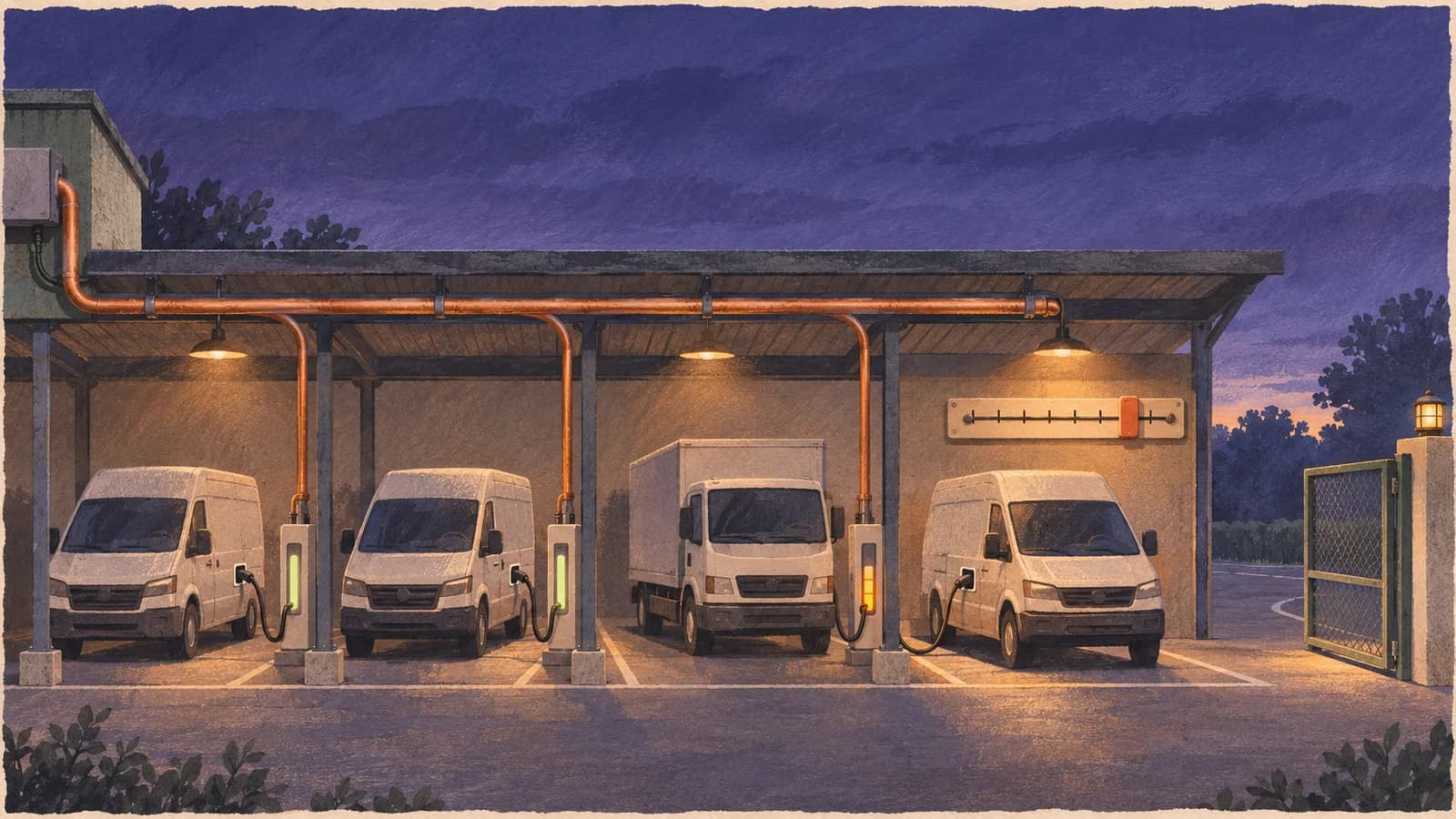
A decision-first guide to fleet charging readiness, site-power constraints, vehicle and charger compatibility, degraded mode, OCPP evidence, system ownership, and software boundaries.
Fleet charging management software decides when and how vehicles charge within operational, electrical and equipment constraints. The hard part is not drawing a lower-cost charging curve. It is ensuring that the right vehicle has enough usable energy for its assigned departure while the depot respects its approved power boundary—and making a failed or uncertain charge visible early enough for operations to act.
Editorial draft: November 20, 2026 · Estimated reading time: 13 minutes
Quick answer
Choose fleet charging management software around departure readiness, not the charger dashboard. Define one charge-readiness contract for each vehicle and assignment: current energy evidence, ready-by time, target usable energy, eligible chargers, accepted power, priority and fallback. Keep the site power ceiling and electrical limits as hard constraints. Then decide whether the charger management system, fleet platform, energy platform or a focused orchestration layer should resolve priorities and exceptions. Pilot at one depot, test degraded modes, and accept the system only when vehicles, sessions, site load and operational decisions reconcile.
Key takeaways
| Question | Decision-first answer |
|---|---|
| What is the primary outcome? | A vehicle ready for its assigned work by the required time without exceeding an approved site boundary. |
| Is a successful charging session enough? | No. Session completion, vehicle energy, assignment readiness and site-load evidence must agree. |
| Should price or peak reduction come first? | No. Optimize cost, peak and renewable use only inside compatibility, safety, power and readiness constraints. |
| Does “OCPP supported” prove interoperability? | No. Record the protocol version, profiles, optional functions, certification evidence and tested device/CSMS combinations. |
| Buy, extend, orchestrate or build? | Configure when one ecosystem fits; extend when an existing platform owns reliable inputs; orchestrate when systems and vendors must share one readiness policy; build only the distinctive control. |
On this page
- Who this guide is for
- Define the outcome
- Create a readiness contract
- Put constraints in order
- Map system ownership
- Design degraded mode
- Treat interoperability as evidence
- Choose the software boundary
- Pilot and accept
- FAQs
Who this guide is for
This guide is for fleet operations directors, depot and facilities leaders, energy managers, electrification teams, product owners, enterprise architects and integration leads evaluating software for return-to-base delivery, service, municipal, transit or other commercial fleets.
It is not electrical engineering, utility, charger-selection, vehicle-safety, cybersecurity, procurement or legal advice. Qualified owners must approve electrical capacity, protection, installation, operating procedures and safety. Software should enforce approved boundaries; it must not invent them.
Define the outcome before selecting software
The U.S. Department of Energy describes managed charging as controlling when and how electric vehicles charge without compromising operational needs. That last condition should lead the design. A depot can produce a smooth load profile and still fail if one priority vehicle is not ready for its route.
Define the accepted outcome in operational terms:
By each ready-by time, the assigned vehicle has verified usable energy at or above its approved target, the charging action stayed within site and equipment limits, and any readiness risk was raised soon enough for an authorized person to choose a fallback.
That definition separates four facts that dashboards often blur:
| Fact | Evidence | Why it matters |
|---|---|---|
| vehicle readiness | vehicle energy state, target and assignment | energy is useful only in relation to work |
| charging execution | connector, session, power and interruption records | a command is not proof that energy arrived |
| site compliance | approved ceiling and measured aggregate load | one successful vehicle must not violate the depot boundary |
| operational response | alert, owner, decision and fallback | software cannot silently absorb a missed departure |
DOE's Smart Charge Management Implementation for Federal Fleets advises teams to gather fleet schedules and dwell periods, facility electrical capacity, energy-rate inputs, IT and cybersecurity requirements, and utility constraints before selecting a solution. Use that as implementation guidance, not as a legal requirement for private fleets.
Create one charge-readiness contract
Build a stable record for the decision the software must make. At minimum, include:
- Vehicle and assignment: stable vehicle identity, operating unit and the specific upcoming work or duty block.
- Ready-by commitment: departure time plus the operational cutoff for escalation or substitution.
- Current energy evidence: state of charge or other approved energy estimate, source, observed time and confidence.
- Target usable energy: the approved operational target, not a universal percentage copied across the fleet.
- Eligibility: compatible charger, connector, vehicle capability, depot bay and any approved restrictions.
- Power acceptance: the maximum power the vehicle and charger combination can accept under current conditions.
- Priority policy: how assignments, remaining dwell, energy deficit and operational criticality are ordered.
- Fallback: alternate charger, vehicle substitution, delayed work, controlled escalation or another authorized response.
- Evidence: session, meter, charger, vehicle and decision records needed to explain the result.
The Alternative Fuels Data Center fleet guidance connects vehicle selection and charging infrastructure to duty requirements, routes, dwell time, electrical capacity and vehicle/charger compatibility. That means the contract is not complete when it contains only a battery percentage and departure time.
Do not treat stale energy data as current truth
A vehicle can report an old state of charge while disconnected, sleeping or out of coverage. Record the observation time and source. Define when the value becomes too old for automatic scheduling. If charger-delivered energy, vehicle telemetry and the assignment record disagree, show the conflict instead of silently choosing the most convenient value.
The target also needs an owner. Operations may require reserve for weather, auxiliary loads, route uncertainty or an unplanned reassignment. The software can apply the approved policy; it should not invent reserve assumptions.
Put the constraints in the right order
Charging control is a constrained scheduling problem. Put non-negotiable boundaries ahead of preferences.
1. Electrical, safety and equipment boundaries
Use only limits approved by the responsible utility, facility, electrical and equipment owners: site capacity, transformer or feeder boundaries, charger limits, connector eligibility, vehicle acceptance, load-control interfaces and safe operating states. Managed charging may defer or shape load; it is not automatically a substitute for electrical upgrades.
The NREL report Electric Medium- and Heavy-Duty Vehicle Charging Infrastructure Attributes and Development explains why depot charging is material: larger vehicle charging can add substantial load, while predictable schedules and dwell periods can create useful flexibility. The design must establish which flexibility is real at this depot.
2. Departure readiness
Within the approved boundary, allocate energy to the commitments at greatest risk. Compare energy deficit, remaining dwell, accepted power and assignment priority. A vehicle that leaves later may charge first if its deficit is large and its available charger is slow. Priority is not simply “earliest departure wins.”
3. Resilience and recovery
Keep enough options to absorb a failed port, interrupted session, late return or changed assignment. An optimizer that fills every minute and every kilowatt with no recovery margin may be efficient only on paper.
4. Cost, peak and energy objectives
Only after the first three layers pass should software compare tariffs, demand peaks, renewable availability or other approved objectives. DOE's managed charging guidance distinguishes simple schedules from adaptive control and treats operational needs as a boundary. Do not present a lower modeled bill as success if readiness or resilience deteriorates.
Map system ownership before integration
Fleet charging crosses systems that observe different parts of reality.
| System | Likely owned facts | Boundary |
|---|---|---|
| fleet / dispatch platform | vehicle assignment, route or duty, ready-by time, substitution | work commitment, not charger truth |
| vehicle or telematics source | vehicle identity, energy state, availability, faults | vehicle evidence with freshness limits |
| charging-station management system | charger state, connector, transaction, command and firmware context | charging execution, not the complete fleet priority |
| facility / energy system | approved site limit, measured load, local control state | electrical boundary and building load |
| utility / tariff source | service limits, program signals, tariff periods | external constraints and price inputs |
| orchestration layer | readiness contract, priority, allocation, conflict and escalation | cross-system decision, not a second source of every fact |
| operations | substitution, delayed departure, manual recovery and exception closure | accountable degraded-mode decision |

Use stable identifiers for depot, vehicle, charger, connector, assignment and session. Preserve source timestamps and time zones. A command identifier, charger transaction, vehicle energy reading and departure commitment should be reconcilable without relying on a mutable display name.
Avoid building a shadow fleet system inside the charger platform or a shadow charger registry inside dispatch. Copy only the fields needed for the decision, retain provenance, and return outcomes to the responsible system.
Design degraded mode before the happy path
List the failures that can threaten a departure:
- vehicle returns later than planned;
- vehicle is parked in the wrong bay or not connected;
- connector is occupied, incompatible or unavailable;
- charger reports available but a start command fails;
- session starts and then stalls or delivers less power than expected;
- vehicle energy evidence is missing, stale or contradictory;
- site limit changes or a local controller takes priority;
- network connection between charger and management system is lost;
- dispatch changes the assignment or ready-by time;
- a software retry creates a duplicate or conflicting command; or
- a manual action occurs outside the planned workflow.
For each failure, define detection evidence, time-to-departure threshold, owner, allowed automatic response, required human decision and closure evidence. Escalate on projected readiness risk, not only after the ready-by time passes.
Local behavior matters when communications fail. Determine which charger or site controller continues a safe local schedule, which commands expire, how power limits are enforced, and how events reconcile when the connection returns. Do not assume that cloud unavailability means chargers either stop safely or continue optimally; verify the implemented behavior.
Make commands replay-safe
Retries must not start duplicate sessions, cancel the wrong transaction or overwrite a newer priority. Bind commands to vehicle, connector, assignment, intended state, creation time and an idempotency or correlation reference where supported. Reconcile an uncertain result before replaying it.
Treat interoperability as tested evidence
The Open Charge Alliance describes OCPP as the communication boundary between charging stations and a management system. Its protocol overview notes that OCPP 2.0.1 adds capabilities including device management, improved transaction handling, security, smart charging and ISO 15118 support; OCPP 2.1 adds further capabilities, including bidirectional charging and distributed-energy-resource control. It also states that OCPP 1.6 and 2.0.1 are not compatible.
“Supports OCPP” therefore leaves important questions unanswered:
- Which exact version and edition is implemented?
- Which profiles and optional functions are supported?
- Is the charger, CSMS or implementation certified for the relevant version/profile?
- How do the actual charger model, firmware and CSMS behave together?
- Which smart-charging commands, transaction flows and offline states were tested?
- How are certificates, keys, firmware, logs and vulnerabilities operated?
Use the alliance's current specification and errata downloads as the source of record, and interpret its certification program as evidence for a defined conformance scope—not proof that every optional function or fleet workflow works. Include operational security using the OCPP Security Operations Guide.
Choose configure, extend, orchestrate or build
| Option | Choose it when | Watch for |
|---|---|---|
| Configure the charger's CSMS | one charger ecosystem, simple schedules and built-in priorities satisfy the readiness contract | charger-centric data model, limited fleet context, vendor lock-in and optional protocol behavior |
| Extend a fleet or energy platform | it already owns reliable assignments or site limits and has credible charger integrations | weak transaction detail, slow control loop, duplicated charger registry or unsupported exceptions |
| Add a focused orchestration layer | multiple charger vendors, fleet systems, depots or energy inputs must honor one operational policy | unclear command authority, split-brain control, excessive data copying and brittle point integrations |
| Build core charging control | the operating model is truly distinctive and product advantage justifies protocol, security and 24/7 operational ownership | rebuilding mature CSMS functions, certification burden, device variance and unsafe failure assumptions |

Buy versus build is usually the wrong first question. Decide what the business must own. A CSMS can remain the system for charger communication while a narrow orchestration layer calculates fleet priority. A fleet platform can own assignments while the site controller enforces a hard local limit. Custom work should connect these responsibilities, not replace every product.
Pilot one depot and accept the operating system
Choose a depot with known duty cycles, reliable vehicle identity, approved electrical capacity, clear operational ownership and enough charging variance to test the decision. Avoid beginning with every site, charger, tariff and vehicle class.
Stage 1: baseline the physical operation
Observe returns, parking, connections, dwell, assignments, charger availability, session interruptions, site load and manual recovery. Validate clocks, identifiers and data freshness. Document the current decision owners.
Stage 2: shadow the readiness policy
Run the scheduler without controlling chargers. Compare projected readiness with actual energy and departures. Review every surprising priority and missed risk. Correct the contract and data before tuning cost objectives.
Stage 3: control a bounded group
Enable a limited set of vehicles and chargers with conservative site limits and explicit manual override. Freeze the tested software, charger firmware, protocol profile and policy version. Keep a rollback path.
Stage 4: exercise degraded modes
Deliberately test a late return, unplugged vehicle, unavailable connector, stale energy reading, session interruption, site-limit change, assignment change and communications loss. Confirm early warning, authorized response and reconciliation.
Stage 5: accept outcomes, not commands
Measure:
- vehicles ready by their approved commitments;
- readiness risks detected before departure;
- energy target and actual energy evidence;
- session starts, interruptions, retries and uncertain results;
- site-limit excursions or local-controller interventions;
- manual overrides, substitutions and unresolved exceptions;
- stale or conflicting vehicle/charger data;
- charger availability and failed-charge impact; and
- charging cost or peak only alongside readiness and resilience.
Do not call the pilot successful because commands were accepted or modeled cost fell. Accept it when physical vehicles, charging sessions, site load and operational decisions reconcile under both normal and failed conditions.
Common mistakes
| Mistake | Consequence | Better approach |
|---|---|---|
| optimizing price before readiness | cheap charging can leave a priority vehicle short | make ready-by energy a hard operational contract |
| treating all ports as interchangeable | schedules rely on impossible vehicle/charger pairings | model eligibility and tested capability |
| trusting stale state of charge | the optimizer acts on a vehicle state that no longer exists | store source time, confidence and freshness thresholds |
| giving two systems command authority | sessions start, stop or reprioritize unpredictably | define one decision authority and one local safety boundary |
| assuming protocol support equals workflow fit | optional behavior and failure modes appear during rollout | test exact versions, profiles, firmware and scenarios |
| alerting only after a missed departure | operations loses its fallback window | project risk continuously and escalate by time-to-departure |
| building a full CSMS unnecessarily | cost and operational burden expand far beyond the differentiator | buy protocol/device management and build the narrow policy layer |
Frequently asked questions
What is fleet charging management software?
It coordinates vehicle charging against assignments, energy targets, dwell time, charger capability, site power and operating policy. Depending on scope, it may be a CSMS feature, fleet or energy platform module, or a separate orchestration layer.
Is fleet charging software the same as a CSMS?
Not always. A CSMS typically manages charging stations, connectors, sessions, commands and protocol communication. Fleet charging also needs assignments, departure commitments, vehicle energy evidence, substitution and operational escalation. One product may cover both, but the responsibilities remain distinct.
Does managed charging avoid an electrical upgrade?
Sometimes load shaping can defer or reduce a constraint, but not universally. Capacity, simultaneous demand, duty cycle, charger power, growth and resilience determine the result. Qualified electrical and utility owners must approve the design.
What data should a pilot start with?
Start with stable vehicle, charger, connector and assignment identifiers; ready-by times; current and target energy; accepted power; charger eligibility; an approved site limit; session evidence; and named exception owners. Add cost and renewable inputs after those contracts are reliable.
What should be custom?
Custom software is most defensible where the fleet's assignment, priority, fallback or cross-system approval policy is genuinely distinctive. Protocol communication, charger administration and commodity device management usually deserve a product-first evaluation.
One-minute decision summary
- Define readiness as a vehicle, assignment, ready-by time and approved energy target.
- Treat electrical, safety and compatibility limits as hard boundaries.
- Map ownership across fleet, vehicle, charger, facility, utility and operations systems.
- Design late returns, failed sessions, stale data and communications loss before automation.
- Verify exact protocol versions, profiles, certification evidence and real device behavior.
- Choose configure, extend, orchestrate or build around the responsibility the business must own.
- Pilot one depot, test failures and accept reconciled operational outcomes—not dashboard activity.
The strongest fleet charging platform is not the one that issues the most commands. It is the one that makes the next departure decision explainable while keeping the depot inside its approved operating boundary.